How to Restart Your Health Routine
After You Fall Off Track
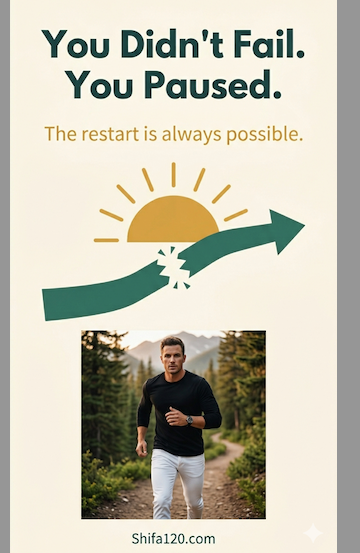
Falling off your health routine is not failure — it is part of the process. Every person who has ever built a lasting health practice has fallen off track. The difference is not who falls. It is who gets back up — and how.
In This Article
- Falling Off Track Is Normal — Not a Character Flaw
- The Four Lies You Tell Yourself After Falling Off
- Why Most Restart Attempts Fail
- The Shifa120 Restart Framework — Six Steps
- The Smallest Possible Step Back In
- Releasing the Guilt That Keeps You Stuck
- The Islamic Framework for Starting Again
- Conclusion — The Comeback Is Part of the Journey
It was going well. The alarm sounded at 4:30 and you got up. The water glass was waiting on the counter. Fajr felt different — more present, more intentional. The walk happened. The journal happened. You were building something real.
And then it stopped. A difficult week at work. A family obligation. Travel. Illness. One missed morning became two, then five, then two weeks. The routine that felt like it was becoming part of you quietly disappeared. And now you are sitting here, several weeks later, wondering how to get back — and feeling something between guilt, frustration, and a low-grade shame that whispers: you always do this.
That voice is wrong. And this article is the answer to it.
Falling Off Track Is Normal — Not a Character Flaw
The research on habit formation and behaviour change is unambiguous on one point: virtually everyone who builds a significant health practice experiences multiple periods of disruption before the practice becomes genuinely stable. The person who exercises consistently for twenty years did not exercise without interruption for twenty years. They stopped and restarted, stopped and restarted — each restart building slightly more neurological infrastructure than the last, until the habit became robust enough to survive the disruptions that inevitably come.
The UCL habit formation study — the most rigorous research on how habits form — explicitly found that missing days does not reset the habit formation process. The neurological encoding that took place in the days before the disruption does not disappear during the disruption. It waits. When you return, you are not starting from zero. You are returning to a partially built structure — and your job is simply to resume building where you left off.
“The person who restarts five times and eventually succeeds is not less disciplined than the person who never stopped. They are braver — because restarting requires more courage than continuing.”
The cultural narrative around health routines presents falling off as evidence of weakness — a moral failure that reveals the person’s true level of commitment. This narrative is not only wrong — it is actively harmful. It creates the conditions under which falling off once leads to staying off for months, because the person has concluded that the fall proves they are not the kind of person who can maintain this practice. The fall proves nothing of the kind. It proves only that they are human.
The Four Lies You Tell Yourself After Falling Off
Before building the restart framework, it is worth naming the specific thought patterns that prevent most people from restarting — because these patterns feel like truth when they are experienced, and they need to be identified clearly before they can be set aside.
“I need to wait for the right moment”
Monday. Next month. After Ramadan. After this project. After the children go back to school. The right moment is a myth. The right moment is always right now — because the next right moment will also have a reason to wait.
“I need to restart from the beginning — everything at once”
The all-or-nothing restart — wake up tomorrow and do everything perfectly from day one — is the approach most likely to fail again immediately. It reloads the full cognitive burden that made the original routine difficult to maintain.
“I have lost all my progress”
Neurological habit encoding does not evaporate in two weeks. The neural pathways built during the active period are reduced in strength but not erased. Re-establishing takes significantly less time than the original formation did.
“This proves I am not disciplined enough”
This is the most damaging lie — because it attacks identity rather than behaviour. Falling off a routine is a situational event, not a personality diagnosis. The disciplined person is not the person who never falls. They are the person who always gets back up.
Why Most Restart Attempts Fail
Most restart attempts fail not because the person lacks commitment — but because they use the wrong strategy. The most common restart strategy is the grand re-launch: an intense declaration of renewed commitment, followed by an attempt to immediately resume the full routine at its previous level of complexity and duration.
This approach fails for a predictable reason. The neurological infrastructure that made the full routine manageable — the partial automaticity that had developed over the weeks of consistent practice — has partially degraded during the disruption. The person returns to a routine that now requires more conscious effort than it did when they stopped. The full routine feels harder than it did at week three. They interpret this as evidence that they have gone backwards. Discouragement follows. The routine stops again.
The Grand Restart Trap
The person who announces on Sunday night “tomorrow I restart everything — 4:30 alarm, full morning routine, exercise, Quran, journaling, healthy eating, no screens” has loaded a cognitive and physical demand onto Monday morning that the partially-degraded routine infrastructure cannot support. By Wednesday, the full restart has collapsed. The solution is not more commitment. It is a smaller, smarter reentry point — one so easy that failure is almost impossible.
The second reason restart attempts fail is guilt-driven overcompensation. The person feels guilty about the time they lost and tries to make up for it immediately by doing more than they were doing before they fell off. They wake earlier, exercise longer, restrict food more severely. This overcompensation is physiologically and psychologically unsustainable. The body and mind rebel. The routine collapses again — and this time with more guilt attached, because the overcompensation attempt has also failed.
The Shifa120 Restart Framework — Six Steps
The restart framework below is built on one principle: re-entry must be easier than continuation was. The goal of the first week back is not to resume full performance. It is to re-establish the neural connection between the anchor and the first habit — to cast one vote for the person you are becoming — and to protect that one vote from the discouragement that comes from attempting too much too soon.
Name What Happened — Without Judgement
Before restarting anything, spend two minutes with a notebook and write one honest sentence about what caused the disruption. Not a list of failures — one sentence. “I stopped when the project deadline came and I never restarted.” This is not self-criticism — it is situational awareness. Understanding what caused the disruption is the first step to building a routine that can survive the next time that same disruption appears.
Decide to Restart — Right Now, Not Tomorrow
The restart does not begin Monday. It does not begin after the current project ends. It begins with the next available anchor — which is almost certainly today. If Fajr has already passed today, the restart begins at the next prayer. If it is evening, the restart begins with the evening wind-down tonight. The moment of decision is the moment of restart. Not tomorrow’s alarm — this moment, this intention, this choice.
Cut the Routine to One Habit Only
Whatever the full routine was — cut it to one habit. Not the easiest habit from the full list. The first habit — the anchor habit that everything else was built on. For most Shifa120 practitioners this is the fixed wake time. Wake at the same time as before. Nothing else is required on day one of the restart. One habit. One victory. One vote cast for the identity you are rebuilding.
Add Back One Habit Every Five Days
After five days of successfully maintaining the anchor habit, add the second habit from the original stack. After another five days, add the third. The five-day interval is shorter than the original two-week addition interval — because you are re-establishing partially encoded habits, not building from scratch. By the end of the first month of restart, the full routine will be back in place — rebuilt correctly, not crammed back in on day one.
Identify the Disruption Trigger and Build a Defence
Whatever caused the original disruption will likely recur. If it was work pressure — build a minimum viable routine for high-pressure periods: one habit only, five minutes maximum, non-negotiable. If it was travel — decide in advance which habits travel with you and which pause. If it was illness — give yourself full permission to pause during illness without guilt, knowing that resumption is automatic on recovery. The routine that survives disruption is not the one with more willpower — it is the one with a pre-decided response to every likely disruption.
Count Restarts as Evidence of Commitment — Not Failure
Every restart is evidence of the same thing: you have not given up. The person who falls off and restarts five times over two years is not less committed than the person who never fell — they have demonstrated their commitment five times more explicitly, by choosing the practice again and again in the face of real difficulty. Reframe every restart not as “I failed again” but as “I chose this again.” Because that is exactly what it is.
The Smallest Possible Step Back In
If the six-step framework feels like too much to process right now — if you are reading this in a state of fatigue or low motivation — there is a simpler version. One question. One answer. One action.
The question: What is the single smallest thing I could do today that would count as a step back toward my health routine?
Not the full routine. Not even the first three habits. The single smallest thing. Examples:
- Wake up at the same time tomorrow — nothing else required
- Drink one glass of water first thing in the morning
- Perform Fajr prayer at its time tomorrow — nothing else
- Write one sentence in the journal tonight before sleep
- Walk for ten minutes — not thirty, not the full workout — ten minutes
- Put the phone in the kitchen tonight instead of beside the bed
The smallest possible step is not a compromise. It is a strategy. The brain’s habit system does not care about the size of the action — it cares about the consistency of the trigger-action sequence. One glass of water after waking, repeated for five days, rebuilds the neural connection between waking and healthy behaviour more effectively than three days of a full routine followed by collapse.
The Two-Minute Rule for Restart
When restarting after any period off, apply the two-minute rule to every habit in the stack. Each habit must be completable in two minutes or less in its restart form:
- Morning walk restart: two-minute walk outside — not twenty
- Quran recitation restart: one page — not three
- Journaling restart: one sentence — not a full reflection
- Exercise restart: five bodyweight squats — not a full session
- Meditation restart: two minutes of quiet — not twenty
The two-minute version of the habit is not the permanent version. It is the door back in. Once you are through the door consistently for five days, extend the duration. But get through the door first.
Releasing the Guilt That Keeps You Stuck
Guilt about falling off a health routine is one of the most counterproductive emotions in the behaviour change process — not because guilt is wrong to feel, but because the way most people respond to it prevents the very action that would resolve it.
The typical guilt response is paralysis. The person feels guilty about not exercising for two weeks, and the guilt itself makes the idea of restarting feel heavy and loaded. Every morning they think about restarting, the guilt of the missed mornings is present — making the restart feel like a confrontation with their own failure rather than simply a return to a practice they value. So they postpone. And the postponement adds more guilt. And the additional guilt makes the restart feel even heavier.
This cycle has one exit: action so small that the guilt has no room to attach to it. Not a dramatic recommitment speech. Not a new plan, a new journal, a new set of goals. One glass of water. One page of Quran. One minute outside. Something so small that the voice of guilt cannot credibly argue it is too difficult. The action breaks the cycle. The cycle broken, the next action is slightly easier. The one after, easier still.
Guilt serves one useful purpose: it signals that something you value has been neglected. Once you have heard that signal and chosen to act on it — the guilt has done its job. Release it. What remains is simply the practice — the daily, imperfect, beautifully ordinary practice of choosing health one morning at a time.
The Islamic Framework for Starting Again
This verse — one of the most beloved in the Quran — contains the complete Islamic framework for restart. Do not despair. Do not give up. Do not conclude from your failure that you are beyond recovery. Turn back. Return. The door is open. It was always open.
The concept of tawbah — repentance and return — in Islam is not a one-time event for major sins. It is a daily, moment-to-moment practice of returning to the right path after any deviation. The word tawbah literally means “to turn back.” Every morning that you wake after a night of poor sleep and poor choices is an opportunity to turn back. Every Fajr prayer is a new beginning — a reset that the Islamic day offers five times every twenty-four hours.
The Prophet ﷺ said: “All of the children of Adam make mistakes. And the best of those who make mistakes are those who repent.” (Tirmidhi). Applied to health and wellness — every person who builds a health practice will have periods of disruption. The best response to those periods is not guilt, not shame, not extended paralysis — it is tawbah. A turn. A return. A simple, quiet, unceremonious recommitment to the practice that serves both body and soul.
The morning after you fell off track is a gift. It is a new beginning presented to you without conditions. The Fajr adhan that sounds regardless of what happened yesterday — regardless of how long you have been away — is the most powerful restart signal available to any human being. When you hear it and respond, you have already restarted. Everything else is detail.
The Fajr Restart — The Simplest Version
If you have fallen off your health routine and do not know where to begin — begin here. Tomorrow morning, when Fajr sounds, get up. Perform wudu. Pray. Nothing else is required. You have restarted. The routine begins at that moment — not next Monday, not after the project, not when conditions are perfect. At that Fajr. At that wudu. At that prayer.
This is the Shifa120 restart in its most essential form. The morning prayer is the anchor. The anchor is always available. The restart is always possible.
The Comeback Is Part of the Journey
There is no health journey without disruption. There is no transformation without the experience of falling off and choosing to come back. The 120 days of the Shifa120 framework are not intended to be 120 perfect days. They are intended to be 120 days in which you keep choosing the practice — imperfectly, inconsistently at times, with interruptions and restarts — until the accumulated weight of those choices becomes the person you set out to become.
You have not lost what you built. The mornings you woke at 4:30 are still encoded. The glasses of water, the pages of Quran, the walks, the gratitude entries — they are still there, waiting for you to return to them. The foundation is not gone. It is simply waiting to be built on again.
Today — not tomorrow, not Monday, not next month — take the smallest possible step back in. One alarm set. One glass of water on the counter for the morning. One intention made before sleep. One vote cast for the person you are still becoming.
The comeback is not the end of the story. It is part of the story. And the story is not over.
Ready to Restart Your 120 Days?
Download the free 7-Day Starter Guide at Shifa120.com and take your first step back in — today, not tomorrow.
Start at Shifa120.com →