The 21-Day Myth —
How Long Does It Really
Take to Build a Habit?
Everyone has heard that habits form in 21 days. It is one of the most repeated claims in self-improvement — and one of the most wrong. Here is what the research actually shows — and why it changes everything about how you build lasting habits.
In This Article
At some point — perhaps from a self-help book, a motivational speaker, or a well-meaning friend — you were told that it takes 21 days to build a habit. Set your alarm earlier for 21 days and it becomes automatic. Exercise every morning for 21 days and you will not be able to stop. Read for 30 minutes every night for 21 days and the habit will be permanent.
You may have tried it. You got to day 21. And then, a few days or weeks later, the habit quietly disappeared. And you concluded — as almost everyone does — that the failure was yours. You lacked discipline. You were not committed enough. You were simply not the kind of person who builds lasting habits.
The failure was not yours. The number was wrong. The 21-day claim is not supported by research. It was never based on a study of habit formation. It was a misquoted observation from a plastic surgeon in 1960 — applied to a completely different context, repeated millions of times, and absorbed into global self-improvement culture as fact. Understanding where it came from, what the real number is, and what actually determines habit formation speed is the foundation of building habits that genuinely last.
Where the 21-Day Myth Came From
The 21-day figure traces back to Dr. Maxwell Maltz, a plastic surgeon who published a book called Psycho-Cybernetics in 1960. In the book, Maltz noted that his patients seemed to take a minimum of about 21 days to get used to seeing their new faces after surgery. He also noted that he himself took about 21 days to form new habits. His exact words were: “it usually requires a minimum of about 21 days for an old mental image to dissolve and a new one to form.”
Two things are important about this observation. First, Maltz said “a minimum of about 21 days” — not “exactly 21 days” and not “habits are formed in 21 days.” Second, he was describing a clinical observation about psychological adjustment after physical surgery, not the result of a controlled study of habit formation in the general population.
Psycho-Cybernetics became one of the best-selling self-help books of all time — selling over 30 million copies. As the book spread, the careful qualifier “minimum of about” was dropped, the surgical context was discarded, and “21 days” became the widely cited figure for habit formation. It passed from book to book, speaker to speaker, article to article, until it became so embedded in popular culture that most people treat it as established science.
“The 21-day habit figure was never the result of a study. It was a clinical observation about plastic surgery patients, misquoted for 60 years. It has caused more habit failure than almost any other piece of self-improvement advice.”
Why the Myth Is Actively Harmful
The 21-day myth does not just fail to help — it actively damages habit formation. When someone tries to build a habit based on the 21-day framework and finds that the habit has not become automatic by day 22, they conclude that something is wrong with them. They abandon the habit. In reality, most habits take two to three times longer than 21 days to reach automaticity — and stopping at day 21 is stopping precisely when the habit is most fragile and most needs to be continued.
What the Research Actually Shows
The most rigorous study of habit formation to date was published in 2010 by Phillippa Lally and colleagues at University College London in the European Journal of Social Psychology. The study followed 96 participants over 12 weeks as they attempted to form a new habit — eating a piece of fruit at lunch, drinking a glass of water before breakfast, or going for a 15-minute walk after dinner. Participants reported daily on whether they performed the behaviour and how automatic it felt.
How Long Does It Actually Take to Form a Habit?
Study design: 96 participants, 12 weeks, daily self-reporting on behaviour performance and automaticity — using the Self-Report Habit Index (SRHI) to measure the degree to which each behaviour had become automatic.
Key finding: The average time for a behaviour to reach automaticity was 66 days — more than three times the commonly cited 21-day figure. The range was from 18 days (for very simple habits in ideal conditions) to 254 days (for complex habits or difficult conditions).
Missing a day: The study also tested the effect of missing occasional days on the trajectory to automaticity. Finding: a single missed day had no significant effect on the overall habit formation curve. Missing one day does not reset the process.
Plateau effect: Automaticity increased rapidly in the early weeks and then plateaued. The habit did not become “more automatic” indefinitely — it reached a ceiling level of automaticity that then remained stable. This plateau, not a fixed number of days, is the real definition of habit formation completion.
The 66-day average is important — but the range is even more important. 18 to 254 days is an enormous spread. A person who tries to build a complex daily habit — a 30-minute exercise routine, a full Quran recitation practice, a morning journaling and meditation sequence — may need significantly more than 66 days to reach genuine automaticity. A person who tries to build a simple single-step habit — drinking a glass of water after waking — may need significantly fewer. The answer to “how long does it take to build a habit” is genuinely: it depends.
The Real Range — 18 to 254 Days
The 18-to-254-day range from the UCL research is the most important finding in habit science — and the most ignored. It tells us that there is no universal habit formation timeline. The same person trying to build two different habits may need three weeks for one and eight months for the other. Understanding where a habit falls in this range is the key to setting realistic expectations and building the persistence that genuine automaticity requires.
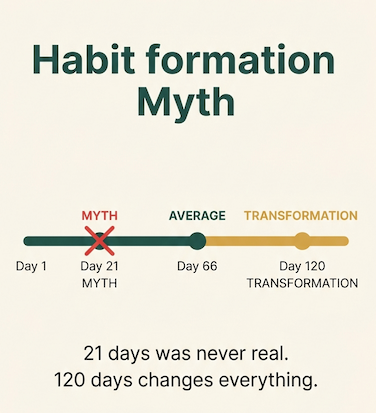
Day 21 — What People Expect
Based on the misquoted Maltz observation. Most people expect their habit to feel automatic here. When it does not — and it usually does not — they conclude they have failed and abandon the practice. This is the point where most habits die. Not because the person lacks discipline, but because they were given the wrong target.
Day 66 — What Research Shows on Average
The UCL study’s average across all habit types and all participants. By day 66, the average participant had reached a plateau of automaticity — the behaviour was happening with significantly less conscious effort than at day 1. Simple habits typically reach this point earlier. Complex habits may not reach it until much later.
Day 120 — Where Real Transformation Lives
The Shifa120 framework targets 120 days — nearly double the research average — because real transformation involves not one habit but a sequence of interconnected habits. Each habit in the sequence takes time to reach automaticity. Building a morning ritual, an evening wind-down, a movement practice, a gratitude practice, and a Quran recitation practice simultaneously requires a longer window than any single habit alone.
What Determines How Long Your Habit Takes
The 18-to-254-day range is not random. Specific, identifiable factors determine where in the range a particular habit will fall. Understanding these factors allows you to predict — roughly — how long your specific habit will take, and to adjust your expectation and your strategy accordingly.
Habit Complexity
The single most important predictor of habit formation speed is complexity. A habit that involves one action — drinking a glass of water — forms faster than a habit that involves a sequence of actions — waking, going to the kitchen, filling a glass, drinking it, then performing wudu. The brain must encode each element of the sequence, and the more elements, the longer the encoding process takes.
Simple Single-Step Habits
One glass of water after waking. Taking a vitamin after breakfast. Writing one sentence of gratitude. The simpler the action, the faster it encodes.
Moderate Multi-Step Habits
A 15-minute morning walk. A 10-minute Quran recitation. A short journaling practice. Multi-step but bounded in time and effort.
Complex Sequence Habits
A complete morning routine. A daily exercise programme. A full language learning practice. Multiple interconnected actions requiring sustained attention.
Consistency of Context
Habits are encoded as context-dependent responses — the brain stores not just the action but the context in which it occurs. A habit practised at the same time, in the same place, after the same trigger, every single day, encodes faster than one practised at variable times and in variable contexts. This is why Fajr prayer — which occurs at a defined time, after a defined trigger (adhan), in a defined physical orientation — is one of the most robustly established habits in the Muslim’s daily life. The context consistency is total. The encoding is therefore exceptionally strong.
Emotional Reward
The brain’s habit encoding system is reward-sensitive. Behaviours that produce a positive emotional response — satisfaction, pride, relief, connection — encode faster than behaviours that feel neutral or effortful. This is one reason that anchoring new habits to existing meaningful practices accelerates formation. Attaching a new habit to Fajr prayer — which already carries deep emotional meaning — borrows some of that emotional reward for the new behaviour. The post-prayer state is one of the most positive emotional states in the practising Muslim’s day — new habits added to this context benefit from the associated reward signal.
Friction and Effort
High-friction habits — those that require significant physical or cognitive effort, preparation, or disruption to the existing routine — form more slowly than low-friction habits. This is why the Shifa120 method recommends starting with the smallest possible version of each habit. Not a 30-minute walk — a 10-minute walk. Not a full Quran juz — three pages. The low-friction version encodes faster and builds the habit infrastructure on which the more demanding version can eventually be built.
Missing Days
The UCL research finding on missed days is one of the most practically important pieces of habit science available: missing one day has no significant effect on the overall trajectory to automaticity. This finding directly contradicts the widespread belief that missing a day “breaks the streak” and requires starting over. It does not. The encoding process continues when you resume. The only thing that breaks the habit-forming process is missing many days in a row — which shifts the pattern from “brief interruption” to “new behavioural baseline.”
Why This Changes Everything
Understanding the real timeline of habit formation changes the relationship between the person building the habit and the inevitable difficulty of the process. Instead of expecting automaticity at day 21 and experiencing failure when it does not arrive, the person who understands the real timeline knows what to expect at each stage and can navigate it correctly.
Days 1 to 21 — The Motivation Phase
In the first three weeks, the habit is running largely on motivation and novelty. The new practice feels fresh, the sense of progress is strong, and the brain’s reward system is engaged by the novelty of the behaviour. This is the easiest phase — not because the habit is becoming automatic but because motivation is high. The danger of the 21-day myth is that people expect this phase to produce automaticity. When the motivation fades at the end of the novelty period, they mistake the end of the easy phase for the end of the habit.
Days 22 to 60 — The Motivation Valley
This is the most dangerous phase — and the phase the 21-day myth makes invisible. The novelty has faded. The habit is not yet automatic. Performing it requires conscious effort and willpower every single day. This phase is described by behaviour change researchers as the “motivation valley” — the period between the end of novelty-driven motivation and the beginning of automaticity-driven momentum. Most habits that fail, fail here. Not because the person lacks discipline, but because they were never told this phase was coming or how long it would last.
Knowing that the motivation valley exists and is temporary — that automaticity is coming on the other side — is the knowledge that allows a person to push through it. The valley is not evidence of failure. It is evidence that the habit encoding process is underway.
Days 61 to 120 — The Automaticity Emergence
Around days 60 to 90 for moderate habits, the behaviour begins to feel different. Less like a decision and more like a sequence. The Fajr alarm sounds and the feet are on the floor before the decision to get up has been consciously made. The journal is open before the conscious intention to write has formed. This is automaticity emerging — the basal ganglia beginning to own the behaviour. By day 120, for most habits in a Shifa120-style programme, this emergence is well advanced. The habit is not yet perfectly automatic for all participants — but it is dramatically easier than it was at day 21.
Why 120 Days Is the Right Framework
The Shifa120 framework is built on 120 days — not 21 days, not 30 days, not 66 days. The choice of 120 days is deliberate and grounded in the research on habit formation for complex behavioural programmes.
A complete morning and evening routine — the kind that produces genuine, lasting transformation — involves not one habit but seven to ten interconnected habits added sequentially over the transformation period. Each individual habit, added one at a time every two weeks, needs its own formation time. When habits are added sequentially rather than simultaneously, the total formation window extends significantly beyond the average for any single habit.
The 120-Day Calculation
- Days 1–14: Fixed wake time only — the foundation habit. Simple, but critical. Formation time: approximately 2–3 weeks.
- Days 15–28: First anchor habit added — water after waking. Simple single-step. Formation: 2–3 weeks.
- Days 29–42: Quran recitation after Fajr added. Moderate complexity. Formation: 4–6 weeks from addition.
- Days 43–56: Morning walk added. Moderate complexity. Formation: 4–6 weeks from addition.
- Days 57–70: Gratitude journal added. Simple but meaningful. Formation: 3–4 weeks from addition.
- Days 71–84: Evening planning added. Simple. Formation: 2–3 weeks from addition.
- Days 85–120: Consolidation — all habits deepening toward automaticity simultaneously. By day 120, the earliest habits are fully automatic. The later habits are well established but continuing to solidify.
By day 120, the person has not just built habits. They have built a complete daily architecture — an intentional structure for the entire waking day that runs with dramatically less conscious effort than it required on day 1.
120 days is also the right framework because it is long enough to survive the motivation valley — which typically occurs between days 22 and 60. A 30-day or 66-day framework sets the endpoint too close to or within the motivation valley. A person who commits to 120 days has already mentally accepted that the hard middle section is part of the journey — not a sign that the journey has failed.
The Islamic Perspective on Consistency Over Time
The Prophet ﷺ said: “The most beloved deeds to Allah are those that are most consistent, even if they are few.” (Bukhari and Muslim)
This hadith contains the most important principle in habit formation — expressed 1,400 years before the UCL research confirmed it from a neurological perspective. Consistency over time is what builds the neurological architecture of automaticity. A small deed performed every day for 120 days is worth incomparably more — in both spiritual and neurological terms — than a large deed performed intensely for 21 days and then abandoned.
The Islamic prayer framework itself demonstrates this. The five daily prayers are not five large, demanding acts performed occasionally. They are five brief, structured acts performed consistently — at defined times, in a defined physical orientation, with defined words. The consistency of their context and the regularity of their repetition is precisely what encodes them as one of the most automatic behaviours in a practising Muslim’s life. Many Muslims find it harder to miss a prayer than to perform it — not because of willpower but because of years of consistent encoding. The prayer has moved from conscious obligation to automatic expression of identity.
This is the model for every habit in the Shifa120 framework. Not intensity — consistency. Not a 21-day sprint — a 120-day steady practice. Not a perfect performance — a regular showing up, even on the difficult mornings, even in the motivation valley, even when the habit feels like effort rather than identity.
The beloved deed is the consistent deed. The consistent deed is the one that encodes. The encoded habit is the one that transforms.
Stop Counting. Start Becoming.
The 21-day figure was wrong. It was always wrong. The real number is 18 to 254 days — with an average of 66 — and the actual number for your specific habit depends on its complexity, the consistency of its context, the emotional reward it produces, and the friction involved in performing it.
This knowledge is not discouraging. It is liberating. It means that when day 21 arrives and the habit does not yet feel automatic, nothing has gone wrong. You are exactly where the research expects you to be. The motivation valley is ahead — and it is temporary. Automaticity is coming. The encoding process is underway in the basal ganglia, below the level of conscious awareness, whether or not you can feel it happening.
Your only job is to keep showing up. Not perfectly. Not intensely. Just consistently. Every morning that you perform the habit is a vote for the identity you are building. By day 120, those votes will have added up to something that no 21-day programme could have produced: a person who does not perform the habit — but is the person the habit describes.
Stop counting days. Start becoming the person. The days will take care of themselves.
Begin Your 120-Day Transformation
Download the free 7-Day Starter Guide at Shifa120.com and take your first step into the real timeline of lasting habit change.
Start at Shifa120.com →