Why You Feel Tired
Every Morning Even After
8 Hours of Sleep
Eight hours in bed but still exhausted when the alarm sounds. You are not lazy and you do not need more sleep. You need to understand why the sleep you are getting is not the sleep your body actually needs.
In This Article
- 8 Hours Is Not the Problem
- The Four Stages of Sleep — Why Quality Matters More Than Quantity
- The Six Reasons You Wake Up Exhausted
- The Morning Cortisol Curve — Your Wake Signal
- Why Fajr Risers Have an Advantage in Sleep Science
- The Seven-Day Fix — What to Change Starting Tonight
- Conclusion — Sleep Is Not a Quantity Problem
You set the alarm for eight hours after you go to bed. You sleep for most of it. The alarm sounds and you are hit by a wave of exhaustion that feels indistinguishable from the tiredness you felt when you lay down. The coffee helps for an hour. By 10am the fog returns. By mid-afternoon you are counting the hours until you can sleep again.
This is not a sleep deprivation problem. Millions of people who sleep exactly eight hours every night feel exactly this way every morning. The eight-hour prescription — the number everyone has been given since childhood — does not tell you anything about the quality, architecture, or timing of the sleep you need. It tells you only one thing: the number of hours. And hours alone are not enough.
The question is not how long you sleep. It is what your body does while you sleep — and whether the conditions you create allow it to do those things properly.
8 Hours Is Not the Problem
The recommendation of eight hours of sleep comes from population-level data — the average duration at which most adults show optimal cognitive performance and health outcomes. It is a reasonable guideline and a useful starting point. But it contains a critical assumption: that all eight-hour sleep periods are equivalent. They are not.
Eight hours of interrupted sleep, delayed sleep, alcohol-affected sleep, or artificially lit sleep produces dramatically different physiological outcomes than eight hours of consolidated, well-timed, dark-environment sleep. The brain and body have specific repair and restoration processes that only occur at specific stages of sleep — and those stages can be disrupted, shortened, or eliminated entirely while the total hours remain unchanged.
“You can spend eight hours in bed and wake up in worse physiological condition than someone who slept six hours at the right time in the right conditions. Hours are the container. What matters is what goes inside.”
Understanding why you wake up tired requires understanding what sleep actually is — not a single state of unconsciousness, but a structured biological programme that cycles through distinct stages, each performing specific functions, each requiring specific conditions to occur properly. When any part of that programme is disrupted — by light, by timing, by stress, by food, by a screen — the consequences appear the next morning as fatigue, fog, and the desperate reach for the snooze button.
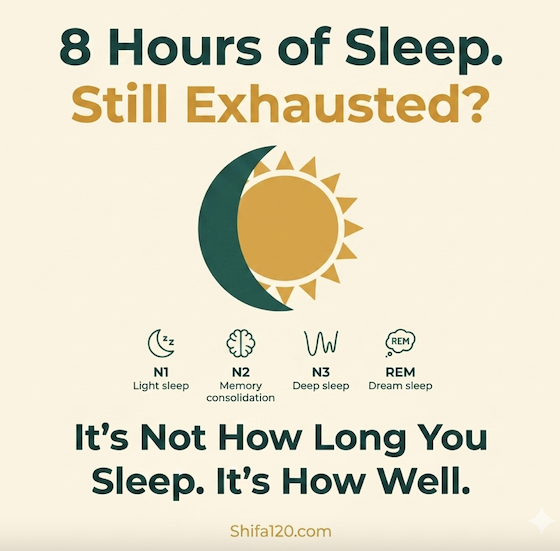
The Four Stages of Sleep — Why Quality Matters More Than Quantity
Sleep is not uniform. Every night your brain cycles through four distinct stages — each serving a different biological function. A complete cycle takes approximately 90 minutes, meaning a typical eight-hour night contains roughly five cycles. If any stage is consistently disrupted or shortened, the functions that stage performs will be incomplete — and you will feel it in the morning.
Light Sleep — The Transition
The entry point into sleep. Brain activity slows, muscles relax, the body temperature drops slightly. Lasts only 1–5 minutes per cycle. Easily disrupted — a sound or light can return you to wakefulness. This stage itself contributes little to restoration, but it is the doorway to deeper, more restorative stages. If you are spending too much time here — cycling between N1 and wakefulness — you are not getting the sleep your body needs.
Consolidated Light Sleep — Memory & Learning
The most frequent stage — approximately 50% of total sleep time. Heart rate slows, body temperature continues to drop. Sleep spindles (bursts of neural activity) appear — associated with memory consolidation and the filtering of irrelevant information. Losing N2 time impacts learning, focus, and the ability to retain what you experienced the previous day. Stress hormones and caffeine consumed too late reduce N2 time significantly.
Deep Sleep (Slow Wave Sleep) — Physical Restoration
The most physically restorative stage. Growth hormone is released — repairing tissues, building muscle, consolidating bone density. The immune system is most active during this stage. Blood pressure drops. The brain clears metabolic waste products including amyloid beta — the protein associated with Alzheimer’s disease. Deep sleep is concentrated in the early part of the night. Alcohol, late eating, and elevated body temperature all suppress deep sleep — even when total hours are maintained.
REM Sleep — Emotional Processing & Creativity
The most mentally restorative stage. The brain is almost as active as during wakefulness. Dreams occur. Emotional memories are processed and integrated — the brain strips the emotional charge from difficult memories while preserving the factual content. Problem-solving, creativity, and emotional regulation all depend on sufficient REM. REM sleep is concentrated in the second half of the night — the hours between 3am and 7am. Waking before these hours are complete cuts REM sleep short, leaving emotional processing incomplete.
The Key Insight — Timing Within the Night Matters
Deep sleep (N3) dominates the first half of the night. REM sleep dominates the second half. This means that the two most critical restorative stages are separated in time. If you go to bed late, you lose the deep sleep window. If you wake up early, you cut the REM window short. Eight hours from midnight to 8am contains a very different sleep architecture than eight hours from 10pm to 6am. Both are eight hours. Only one delivers complete restoration.
The Six Reasons You Wake Up Exhausted
Most cases of morning exhaustion after adequate sleep hours trace back to one or more of these six causes. Identify which apply to your situation — the fix requires understanding the cause first.
Sleep Inertia — Waking from Deep Sleep
If your alarm wakes you during deep sleep (N3), your brain is in its most unconscious state. The physiological transition from deep sleep to wakefulness takes 15–30 minutes. During this window — called sleep inertia — reaction time, memory, and cognitive function are severely impaired. The grogginess feels identical to sleep deprivation. It is not. It is timing.
FIX: Consistent wake time — same time every dayLight Exposure Before Sleep — Melatonin Suppression
Melatonin is the hormone that signals the brain to prepare for sleep. It begins rising approximately two hours before your natural sleep time — but only in darkness. Screens, overhead lighting, and LED bulbs emit blue-spectrum light that suppresses melatonin production as effectively as daylight. Using a phone or laptop for one hour before bed can delay melatonin onset by 90 minutes — pushing you into sleep 90 minutes late even when you lie down on time.
FIX: No screens 60 min before sleep — dim warm light onlyElevated Cortisol — The Stress Saboteur
Cortisol is a stress hormone that should be at its lowest during the first half of the night to allow deep sleep to occur. Chronic work stress, unresolved emotional tension, and exposure to emotionally activating content (news, arguments, difficult conversations) before sleep keeps cortisol elevated. Elevated cortisol directly suppresses deep sleep and causes multiple brief arousals throughout the night — arousals you may not consciously remember but which fragment your sleep architecture completely.
FIX: Evening wind-down routine — 30 min before sleepLate Eating — Core Temperature Disruption
The body’s core temperature must fall by approximately 1°C to initiate and maintain deep sleep. Digestion raises core body temperature — the opposite of what deep sleep requires. Eating within two to three hours of sleep, particularly high-carbohydrate or high-fat meals, significantly suppresses deep sleep quantity. The total hours of sleep remain the same but the restorative deep sleep stage is reduced, and you wake feeling as if you did not sleep at all.
FIX: Last meal at least 2–3 hours before sleepIrregular Sleep Timing — Circadian Disruption
The circadian rhythm is the brain’s 24-hour internal clock — governing the precise timing of cortisol, melatonin, body temperature, and dozens of other physiological processes. It is anchored primarily by light exposure and sleep timing. Varying your sleep and wake time by even 60–90 minutes across days — sleeping late on weekends, staying up later some nights — disrupts the circadian clock. The result is a body that cannot synchronise its restorative processes to your actual sleep window. Social jetlag — the gap between biological clock and social schedule — is one of the most underrecognised causes of chronic morning fatigue.
FIX: Same sleep and wake time 7 days a week — no exceptionsDehydration During Sleep — Overnight Water Loss
The body loses approximately 500ml of water overnight through respiration and perspiration. Mild dehydration — even 1–2% reduction in body water — produces fatigue, reduced cognitive function, and headaches that are often identical in presentation to sleep deprivation. Waking up tired, with a dull headache and dry mouth, and finding that a large glass of water improves your clarity within 20 minutes — is a sign that dehydration is contributing to your morning fatigue. In hot climates like the Gulf, overnight water loss can be significantly higher.
FIX: Large glass of water within 5 minutes of wakingThe Morning Cortisol Curve — Your Natural Wake Signal
Cortisol is often described only as a stress hormone — but that description misses its most important role in the morning. In a healthy circadian rhythm, cortisol rises sharply in the first 30–45 minutes after waking — a phenomenon called the Cortisol Awakening Response (CAR). This surge is the body’s natural alarm system. It activates the immune system, sharpens cognitive function, mobilises blood glucose for energy, and signals to every cell in the body that the day has begun.
When the CAR is blunted — by chronic stress, sleep disruption, or the habit of lying in bed scrolling after waking — the natural energy signal fails to arrive. The person lies in bed, or sits groggily in bed on their phone, waiting to feel awake. The feeling never fully arrives because the signal that produces it was never properly triggered.
The single most powerful action for morning energy is not coffee. It is sunlight within the first 10–15 minutes of waking. Morning sunlight exposure — even on a cloudy day — delivers a light signal to the suprachiasmatic nucleus (the brain’s master clock) that confirms the time of day, amplifies the cortisol awakening response, and sets the entire circadian cascade in motion for the next 24 hours. It also sets the melatonin timer — ensuring that melatonin rises at the correct time 14–16 hours later, producing natural sleepiness at the appropriate time that night.
The Morning Light Protocol — Two Minutes That Change Everything
After Fajr prayer, before checking any screen: go outside or stand at a window facing the sky for 2–10 minutes. No sunglasses. Allow the morning light to reach your eyes directly. This single practice — repeated consistently — recalibrates the circadian clock, amplifies the cortisol awakening response, and improves sleep quality the following night. It costs two minutes. The return is hours of better cognitive function across the day.
Why Fajr Risers Have an Advantage in Sleep Science
Fajr prayer time — approximately 90 minutes before sunrise across most of the year in the Gulf region — falls within one of the most scientifically significant windows of the 24-hour period. Understanding why reveals something remarkable about the alignment between Islamic practice and human biology.
In the hour before sunrise, cortisol has already begun its pre-dawn rise — a process called the cortisol pre-awakening response. The body is physiologically priming itself for wakefulness before the eyes open. Waking at Fajr — before full sunrise — means the Fajr riser is waking at a time when the body is already preparing to wake. The transition is gentler, the alertness arrives faster, and the morning light from Fajr to sunrise provides the full-spectrum light signal that anchors the circadian clock for the day.
The person who sleeps until 8am, 9am, or 10am is waking during or after the cortisol peak has already passed — into a period where cortisol is already beginning its mid-morning decline. The early morning energy advantage has been missed. The light signal that anchors the clock has been partially missed. And because the sleep was pushed into the late morning hours, the REM sleep — which was already abundant between 3am and 6am — was achieved in excess, producing the heavy, groggy feeling that comes from oversleeping REM.
The baraka of the early morning hours — the hours from Fajr to mid-morning — is one of the most consistent themes in the Sunnah. The Prophet ﷺ made a specific supplication for blessing in these hours. Modern sleep science reveals that these hours are also when the cortisol awakening response is at its peak, the mind is sharpest, and the circadian biology of the human body is most optimally calibrated for focused, productive work. The blessing of Fajr is not merely spiritual — it is written into the architecture of the human body.
The Seven-Day Fix — What to Change Starting Tonight
Every one of the six causes of morning exhaustion is reversible — most within 3–7 days of consistent change. The interventions below are ranked by impact. Start with the first and add one every two days.
Fix Your Wake Time First — Not Your Bedtime
Set a consistent wake time and hold it every single day — including weekends. The circadian clock anchors to the wake time more strongly than the sleep time. A consistent wake time within 3–5 days will cause natural sleepiness to arrive at the correct time the night before — allowing sleep onset to self-correct without forcing it.
Morning Light — Within 10 Minutes of Waking
After Fajr or immediately after waking — go outside or face a bright window for 2–10 minutes without sunglasses. This is the single highest-impact intervention for sleep quality and morning energy available without any cost or equipment.
Cut Screens 60 Minutes Before Sleep
Put the phone in another room. Turn off the television. Dim all lighting to warm tones. This allows melatonin to begin rising on schedule — ensuring you feel genuinely sleepy at the right time and fall into deep sleep without the 60–90 minute delay that screen use causes.
Finish Eating 2–3 Hours Before Sleep
The last meal of the day should be complete at least two hours before you intend to sleep — three hours is better. This allows core body temperature to begin falling before sleep onset, enabling the deep sleep stage to occur fully during the early part of the night.
Large Glass of Water Immediately on Waking
Before coffee, before prayer ablution — drink 400–500ml of water within the first five minutes of waking. This reverses the overnight dehydration that contributes to morning brain fog and fatigue. The effect on mental clarity is noticeable within 15–20 minutes.
Evening Wind-Down — 20–30 Minutes Before Sleep
Cortisol cannot drop rapidly on command — it requires a deceleration period. Spend the 20–30 minutes before sleep in low-stimulation activity: reading, light stretching, Quran recitation, or quiet reflection. Avoid news, arguments, work emails, and emotionally activating content. This allows cortisol to fall naturally, enabling the transition into sleep without the fragmented light sleep that elevated cortisol produces.
Keep the Room Dark and Cool
Any light entering the bedroom during sleep — from streetlights, phone notifications, or standby LEDs — can activate light-sensitive cells in the eyes even through closed eyelids, partially suppressing melatonin and increasing the frequency of brief arousals. Blackout curtains or a sleep mask. Room temperature between 17–19°C if possible — the body needs to lose heat to maintain deep sleep. In hot climates, a fan or air conditioning set cooler than your daytime preference significantly improves deep sleep quantity.
When These Changes Are Not Enough
If you have consistently applied all seven interventions for 2–3 weeks and still wake exhausted after 7–8 hours, consider speaking with a doctor about sleep apnoea — a condition where breathing repeatedly stops during sleep, causing hundreds of brief arousals per night without conscious awareness. Sleep apnoea is extremely common, significantly underdiagnosed, and completely explains the experience of sleeping for eight hours and waking as if you did not sleep at all. It requires medical assessment and treatment — not lifestyle adjustment alone.
Sleep Is Not a Quantity Problem
The eight-hour recommendation is a floor, not a ceiling — and it is not a guarantee. Eight hours of sleep in the wrong conditions, at the wrong time, with the wrong preparation, produces the same morning exhaustion as sleeping four hours. The architecture matters. The timing matters. The environment matters. The hour before sleep matters as much as the sleep itself.
Start with the wake time. Fix that first, hold it for seven days, and add morning light exposure immediately after waking. These two changes alone — implemented consistently — will produce measurable improvement in morning energy within one week for most people. Add the remaining five interventions over the following two weeks. By day 21, the programme will be feeling less like effort and more like the natural rhythm your body was designed to follow.
The Shifa120 framework begins with the morning — because the morning is where the quality of the previous night’s sleep is revealed, and where the quality of the coming night’s sleep is determined. Every morning practice in the programme is designed around the science of what the body needs in the first hour of the day. The wake time. The water. The light. The movement. The prayer.
Fix the morning and you fix the night. Fix the night and you fix the day. The transformation begins at the alarm — not when it sounds, but in how you respond to it.
Transform Your Mornings in 120 Days
Download the free 7-Day Starter Guide at Shifa120.com and begin building the morning that changes everything — tonight.
Start at Shifa120.com →