Good. Now expanding the post properly — adding depth to the subconscious section, the science behind silence, and the morning struggle. Same voice throughout.
SHIFA120 — S1 E2
I Walk Every Morning and Evening. But Not The Way Anyone Else Walks.
A million people walk every day. Most of them are not getting what I get. Here is the difference.
First — the hardest part nobody talks about
Waking up before 3:30 AM is not a fitness habit.
It is a decision you make before you open your eyes.
Every morning when the alarm sounds, your body sends one clear message — stay. It is warm. It is dark outside. The bed is the easiest thing in the world at that moment. Your mind starts building reasons. Five more minutes. It is cold. I walked yesterday. I will go tomorrow.
Every person who has ever tried to build a morning discipline knows this exact battle. It happens every single day without exception.
So how did I get up every day for 120 days without missing once?
I did not think about walking. I did not think about health targets or blood sugar numbers or weight or doctor reports. I did not motivate myself with fitness goals.
I put my children’s faces in front of me.
Their future. My family depending on me. My own ambitions — the things I had not yet done, the version of myself I had not yet become. I looked at everything I wanted to protect and everything I still wanted to build. And I asked myself one question in that dark, quiet moment before my feet touched the floor:
Is this the step that returns everything back to me?
The answer was always yes.
That single thought moved my feet every morning. Not discipline in the abstract sense. Not willpower as people usually describe it. A reason. A clear, personal, emotional reason that was bigger than the comfort of staying in bed.
After a few days, the body stops arguing. It accepts the new instruction. The resistance becomes smaller each morning until eventually there is no resistance at all — only routine. But those first days you do not fight with your body. You give it a reason it cannot argue against.
Find your reason before you start. Write it down if you must. Keep it where you can see it from your bed. Everything else builds from there.
The medicine years
I took medicine for diabetes for a long time.
I followed prescriptions. I attended appointments. I did what the system told me to do. The numbers were managed — not cured, not reversed, just managed. Controlled within a range that doctors considered acceptable.
But acceptable is not well.
I was tired in the afternoons. My mind was not sharp. My body felt older than my age. The energy I remembered from younger years felt like it belonged to someone else. Medicine was doing its job — but its job was to maintain the condition, not to remove it.
I wanted more than maintenance. I wanted my life back.
Walking — the right kind of walking — became the thing that medicine could not give me.
Why my walking is different from everyone else
Every doctor in the world recommends walking to diabetic patients. Every health article, every wellness programme, every nutritionist. Walking is the most universally given advice in the history of medicine.
And millions of people walk every single day.
They walk in parks, on treadmills, along roads and footpaths. They track their steps on their phones. They set targets — 7,000 steps, 10,000 steps. They feel good about the numbers.
But most people walk while listening to music through earphones. Or talking on the phone. Or watching videos. Or planning their day. Or replaying arguments in their head. Or worrying about money, about work, about everything that is waiting for them when the walk ends.
They are moving their legs. Their mind is somewhere else entirely.
This is walking as physical exercise only. It has real benefits — cardiovascular health, blood circulation, joint movement. I am not dismissing it.
But it is only half of what walking can give you.
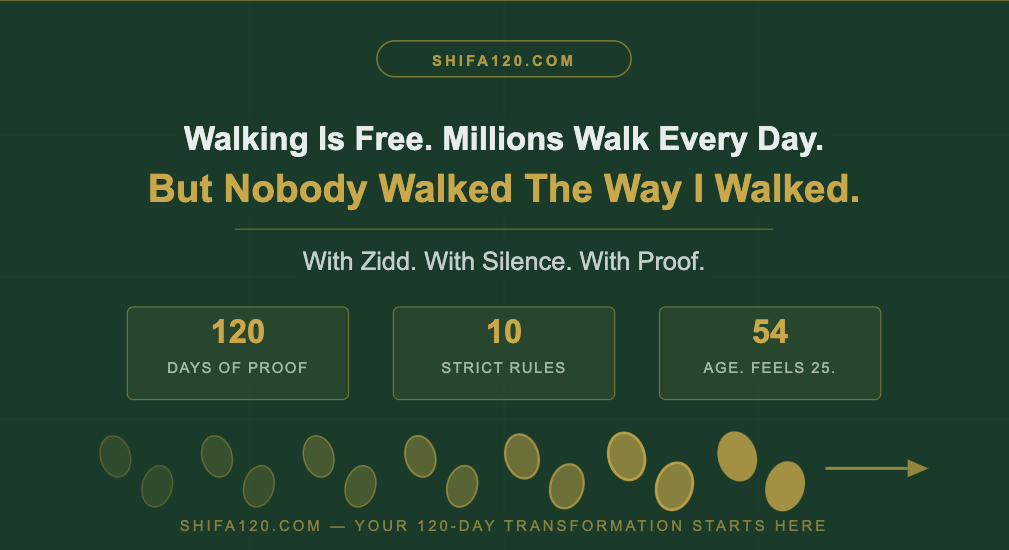
My walking is different. And the difference comes from ten rules I followed without exception from Day 1.
The 10 Rules
1. No water during the walk. Begin hydrated before you leave. Once you start — you finish. No stopping for water breaks. This is a short walk, not a marathon. Your body can manage. The rule trains commitment.
2. No music. Remove the earphones completely. Silence is not emptiness. Silence is the environment your subconscious mind needs to surface. The moment you put music in your ears, you are feeding your mind someone else’s rhythm and emotion. Your own thoughts cannot compete.
3. No talking. Not one word to anyone. If someone greets you — nod. Do not engage in conversation. Your energy and attention stay inside. Every word spoken outward is attention taken away from inward.
4. No rest — once you start, you finish. The walk is short and fixed. But you complete it without stopping under any circumstance. This is not about physical endurance. It is about teaching your mind that when you begin something, you finish it. This habit transfers into every other area of life.
5. No watching — eyes on your steps only. No looking at shops, at people, at phones, at anything interesting along the route. Eyes down. Watch your feet moving forward. Your visual system is one of the most powerful attention-capturing systems in your body. When you give it nothing to process, the energy goes inward.
6. One route only. The same path every single day. This sounds boring. It is intentional. When the route is familiar, your brain stops using energy to process the environment. Navigation becomes automatic. The freed mental energy goes deeper.
7. Fixed time. Morning. Evening. Same time every day without variation. The body has a biological clock. When you walk at the same time daily, your body begins preparing itself before you even start — hormone levels, digestion, mental state. Fixed time turns a practice into a programme.
8. Bring your best moments into your mind. This is the most important rule. While walking, I deliberately bring only positive memories to my conscious mind. The happiest moments of my life. Moments of achievement. Moments of being with people I love. Moments where I felt completely alive. I replay them intentionally, one by one, with full feeling.
9. Zero worry. Whatever problem exists in my life — it is banned from this walk. Financial pressure, work deadlines, family concerns — none of it enters. This is not denial. This is scheduling. Problems will still be there when the walk ends. They do not need these twenty minutes.
10. No planning. This walk is not thinking time. It is not problem-solving time. It is not strategy time. There are no decisions to make here and no to-do lists to build. This is feeling time. Pure, undistracted, inward feeling.
What these ten rules actually do — the mechanism
When you remove music, conversation, watching, planning and worrying simultaneously — you have removed every major external demand on your attention.
Your five senses have nothing significant to process.
All the mental energy that normally flows outward — toward sounds, sights, conversations, plans — has nowhere to go. It turns inward. And what is inward, waiting beneath the noise of daily life?
Your subconscious mind.
Science confirms what many traditions have known for centuries. When the brain is relieved of external demands, it activates what researchers call the default mode network — the part of the brain responsible for self-reflection, memory consolidation, and emotional processing. Walking simultaneously stimulates the prefrontal cortex, which governs focus and emotional regulation, while activating the vagus nerve, which shifts the body from stress mode into calm.
In simple terms — silent intentional walking puts your brain into its most receptive and restorative state.
This is the state I use every morning and evening to do something very specific.
The subconscious is the real destination
Every experience of your entire life — every joy, every pain, every achievement, every failure, every moment of love, every moment of fear — is stored in your subconscious mind.
It never leaves. Every good memory you have ever made is still there. Perfectly preserved.
The problem is that most people spend their days feeding the surface of their mind with worry, stress, news, comparison, and regret. The best experiences get buried under the weight of daily pressure. The subconscious starts presenting fear and stress by default because that is what it receives most.
My walking reverses this deliberately.
By bringing my happiest memories, my strongest feelings of joy, my clearest moments of love and achievement to the surface — during a state where my mind is fully receptive — I am retraining what my subconscious presents to me automatically throughout the day.
Your subconscious mind cannot distinguish between a memory you are vividly replaying and a reality you are currently living. When you relive a moment of deep happiness with full feeling, your brain produces the same chemistry it produced when that moment first happened. Serotonin. Dopamine. The physical sensations of wellbeing.
This is not positive thinking in the shallow sense people usually mean. This is a daily physical practice of feeding your deepest mind with the best material it already contains.
What happened at age 54
I am 54 years old.
Physically — the medical reports speak clearly. Blood sugar reversed to normal range. Weight reduced without starvation. Energy levels restored to what I had not felt in over a decade. My doctors saw the results and asked what I had changed.
I told them: I walk. Silently. With intention.
But something happened beyond the physical results that I find harder to explain in medical language.
Mentally — I feel 25.
Not as a figure of speech. As a real, daily experience.
The heaviness that builds over decades — responsibility, distance from family, health anxiety, financial pressure, the slow accumulation of difficult years — that heaviness has lifted. Not completely in one day. Walk by walk, morning by morning, over 120 days.
Each good memory brought to the surface during walking made that memory more accessible in ordinary life. Each replayed moment of joy began appearing naturally in how I think, how I respond to difficulty, how I start each day.
At 54, physically I am 54. But mentally — in terms of energy, optimism, clarity, and the feeling of possibility — I am experiencing something I associate with being 25. This is what intentional subconscious work through silent walking produced in me.
You may not believe this until you experience it yourself. I did not believe it was possible until I lived it.
What I gained
— Blood sugar returned to normal range and stayed there — Weight reduced naturally without any starvation or extreme dieting — Mental clarity that had been missing for years fully restored — Energy that sustains from the first alarm until the evening walk ends — A feeling of youth and possibility that has no single medical explanation — A daily discipline that transferred into every other area of my life — work, relationships, creativity, focus
What I lost
— The need for several medications I had been taking for years — Afternoon energy crashes that had become normal — The mental heaviness of accumulated stress that I had accepted as part of ageing — The belief that my best years were already behind me
One last thing
I am not a doctor. I am not a researcher or a fitness professional.
I am a man who was sick for years, who followed the conventional path without the results he needed, who then designed his own approach based on what his body and mind actually responded to — and who documented every single step.
The walking I have described above costs nothing. No equipment. No gym membership. No app subscription. No special shoes required.
It requires exactly one thing before everything else.
A reason strong enough to lift you out of a warm bed before the sun rises — on the first day, and every day after.
Your children. Your family. Your health. Your unfinished life. Whatever it is — find it, hold it in your mind every morning, and let it move your feet.
The rest will follow.
This is my real story. Nothing added. Nothing exaggerated. Medical reports available on this platform.
Full 120-day transformation programme: shifa120.com Available 24 hours, 7 days a week.