I remember sitting in the clinic looking at my blood test results.
The numbers were not good. My blood sugar was high. My doctor looked at me seriously and said the words I had been dreading.
“We need to talk about starting medication.”
I was not ready to accept that. Not yet.
I asked for 120 days.
He agreed — reluctantly.
What happened in those 120 days changed my health, my body, my mind and my life completely.
This is not a theory. This is not something I read in a book. This is what I lived — day by day — for 120 days.
What the Doctor Told Me
High blood sugar over time damages blood vessels, kidneys, eyes and nerves. Uncontrolled diabetes leads to serious complications. Medication helps control the numbers — but it does not fix the cause.
I understood all of this. But I also understood something else.
Type 2 diabetes in most cases is not a genetic sentence. It is a lifestyle condition. Which means — in most cases — it can be addressed with lifestyle.
I was not willing to start medication before I had tried everything in my control.
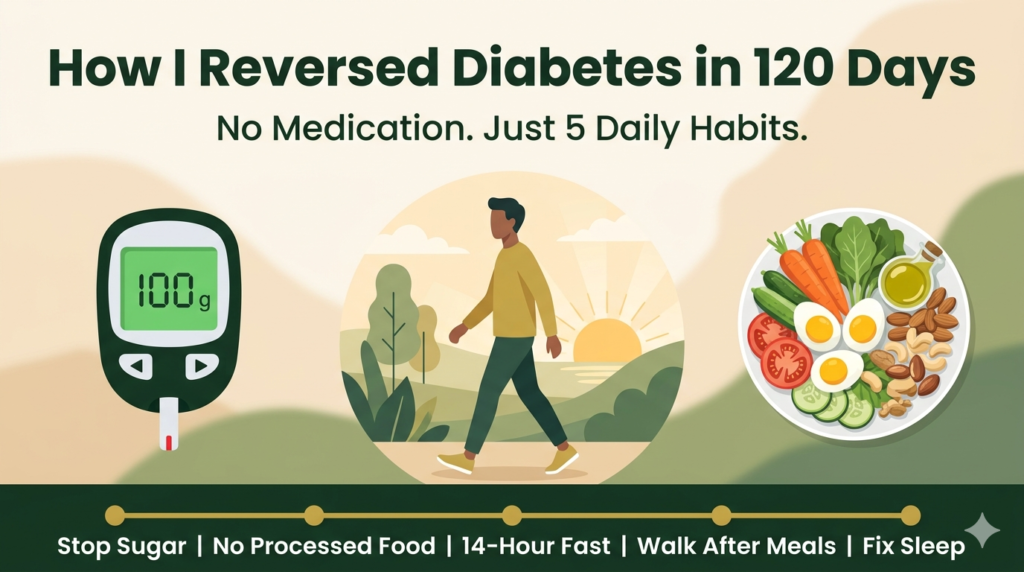
So I designed my own 120-day protocol. Five changes. No shortcuts. No exceptions.
The 5 Changes I Made
Change 1 — I Stopped Refined Sugar Completely
Not reduced. Not occasionally. Stopped.
No white sugar. No sugary drinks. No biscuits, sweets, desserts, juices or anything with added sugar.
The first week was the hardest. My body had been running on sugar for years. It complained loudly — headaches, cravings, irritability.
By week two — the cravings reduced dramatically.
By week four — I no longer missed it.
What happens when you stop sugar:
Your blood glucose stops spiking every few hours. Your pancreas stops working overtime producing insulin. Insulin sensitivity begins to recover. Inflammation in your body starts to reduce.
Sugar is not just calories. It is a metabolic disruptor. Removing it is the single most powerful thing you can do for blood sugar control.
Change 2 — I Eliminated Processed Flour and Junk Food
White bread. White rice. Packaged biscuits. Fast food. Processed snacks.
All of it — gone.
These foods convert to sugar in your blood almost as fast as eating pure sugar itself. The glycaemic index of white bread is higher than table sugar.
I replaced them with:
- Whole vegetables — especially leafy greens
- Lentils and legumes
- Eggs
- Nuts — almonds, walnuts
- Olive oil
- Whole grains in small quantity
Real food. As close to its natural state as possible.
Change 3 — I Started a 14-Hour Fasting Window
I ate between 10 AM and 8 PM only.
Nothing before 10 AM. Nothing after 8 PM. Water, black coffee and green tea were permitted.
This is intermittent fasting — 14 hours of fasting, 10 hours of eating window.
What this does to your blood sugar:
During the fasting hours your insulin levels drop to baseline. Your liver stops producing excess glucose. Your body begins burning stored fat for energy. Insulin sensitivity improves significantly.
After 30 days of consistent fasting I noticed something remarkable. My morning fasting blood sugar — the most important number for diabetes — began dropping week by week.
Change 4 — I Walked After Every Meal
Not a long walk. Not a gym session.
Just 10 to 15 minutes of walking after every meal.
This one habit has more scientific evidence behind it than almost any other lifestyle intervention for blood sugar control.
When you walk after eating:
Your muscles absorb glucose from the blood directly — without needing insulin. Blood sugar spike after the meal is reduced by 30 to 50 percent. Over time your body becomes more efficient at managing glucose.
Morning walk. After lunch walk. After dinner walk.
Three short walks per day. Every single day. No exceptions.
Change 5 — I Fixed My Sleep and My Morning
I began waking at 3:30 AM.
Tahajjud prayer. Fajr prayer. Quran recitation. Quiet reflection before the world started.
This is not just spiritual practice — though spiritually it transformed me.
Chronically poor sleep raises cortisol. High cortisol raises blood sugar. Consistently. Every night of poor sleep makes diabetes worse.
Fixing my sleep — going to bed early, waking early, maintaining a consistent schedule — reduced my cortisol levels and directly improved my blood sugar numbers.
The morning quiet also eliminated stress. And stress — through cortisol — is one of the most underestimated drivers of high blood sugar.
What Happened After 120 Days
I went back to the clinic.
New blood tests. Same doctor.
He looked at the results. Then he looked at me. Then at the results again.
The numbers had returned to normal range.
He asked me what I had done. I told him. He sat quietly for a moment.
Then he said: “Keep doing exactly what you are doing.”
The medication conversation was over.
What I Want You to Know
I am not telling you to refuse medication. If your doctor prescribes it — follow your doctor’s advice. Medication saves lives.
What I am telling you is this:
Lifestyle changes are not alternative medicine. They are the foundation of all medicine.
No medication works as well in a body that is still consuming sugar, processed flour and sitting still all day.
And in many cases — with consistent lifestyle discipline — the body has a remarkable ability to recover.
Your pancreas wants to work correctly. Your cells want to be insulin sensitive. Your liver wants to function properly.
You just have to stop interrupting their natural function with the wrong food, wrong sleep and wrong habits.
The 5 Changes — Summary
| Change | What I Did | Why It Works |
|---|---|---|
| 1 | Stopped refined sugar completely | Reduces insulin demand — reduces inflammation |
| 2 | Eliminated processed flour and junk food | Stops blood sugar spikes — reduces glycaemic load |
| 3 | 14-hour daily fasting window | Lowers baseline insulin — improves insulin sensitivity |
| 4 | Walked 10-15 minutes after every meal | Muscles absorb glucose directly — reduces post-meal spike |
| 5 | Fixed sleep — woke early — reduced stress | Lowers cortisol — cortisol directly raises blood sugar |
Where to Start
Do not try to do all five at once.
Start with one.
Start with the walk after dinner tonight.
Just 10 minutes. Around your building. Around your street. Anywhere.
Do it again tomorrow. And the day after.
Then add the second change. Then the third.
By day 30 you will feel different. By day 60 your numbers will start moving. By day 120 — go back to your doctor.
Let the blood test tell the story.
Important Note
Always consult your doctor before making changes to your diabetes management plan. Do not stop prescribed medication without medical supervision. This article describes my personal experience and is not medical advice.
This article is part of the Shifa120.com wellness platform — dedicated to natural health transformation through daily discipline. For more articles on fasting, nutrition, sleep and morning routines — explore the blog.