Published by Shifa120.com | Your 120-Day Health Transformation Journey
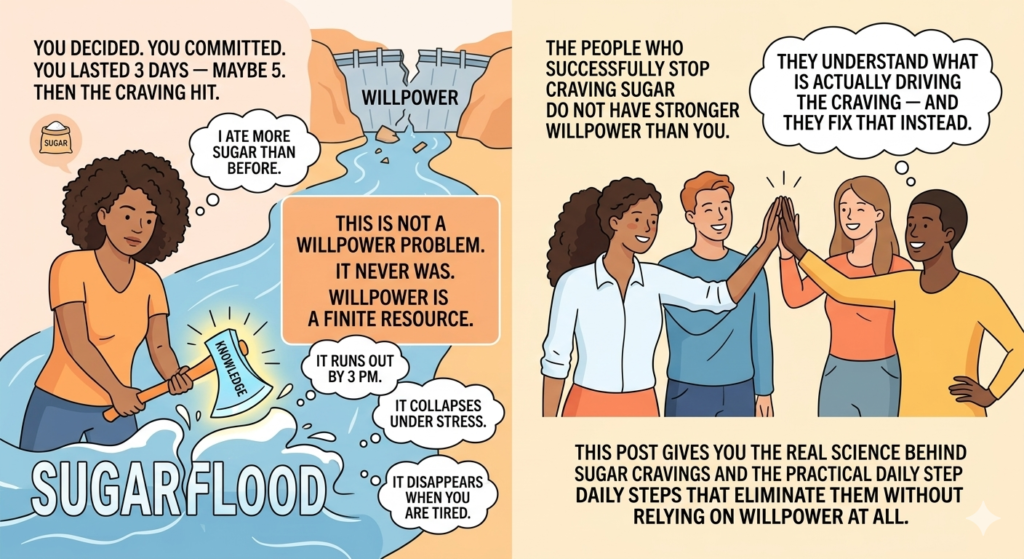
You have tried to stop eating sugar before.
You decided. You committed. You lasted three days — maybe five. Then the craving hit so hard you ate more sugar than before.
This is not a willpower problem. It never was.
Willpower is a finite resource. It runs out by 3 PM. It collapses under stress. It disappears when you are tired, hungry, or emotionally low. Relying on willpower to fight sugar cravings is like trying to hold back a flood with your hands.
The people who successfully stop craving sugar do not have stronger willpower than you. They understand what is actually driving the craving — and they fix that instead.
This post gives you the real science behind sugar cravings and the practical daily steps that eliminate them without relying on willpower at all.
Why You Crave Sugar — The Real Reason
Most people believe sugar cravings are a character weakness. A lack of discipline. An inability to say no.
That belief is wrong and it is keeping you stuck.
Sugar cravings are a biological signal. Your body is telling you something is missing or out of balance. When you understand what is actually driving the craving, you can address that cause instead of fighting the symptom.
Here are the main biological drivers of sugar cravings:
Blood sugar crashes. When you eat refined carbohydrates or sugary foods, your blood glucose spikes rapidly. Your body releases insulin to bring it back down. But often it overcorrects — blood sugar drops below the comfortable baseline. Your brain responds with an urgent signal: eat sugar now. This is not weakness. This is your brain protecting itself from hypoglycaemia.
Chromium and magnesium deficiency. These two minerals are essential for blood sugar regulation. Most people eating a modern diet are deficient in both. When chromium is low, insulin cannot do its job efficiently. The result is stronger and more frequent sugar cravings.
Sleep deprivation. A single night of poor sleep increases levels of ghrelin (the hunger hormone) and decreases leptin (the fullness hormone). It also specifically increases cravings for high-sugar, high-carbohydrate foods. This is not random — your sleep-deprived brain is seeking a fast energy source.
Emotional triggers. Sugar activates the dopamine reward system in the brain. When you are stressed, lonely, bored, or anxious, your brain seeks that dopamine hit. The craving feels like hunger but it is actually an emotional need looking for a quick chemical solution.
Gut microbiome imbalance. Certain bacteria in your gut actually feed on sugar. When they are dominant, they send chemical signals that the brain interprets as cravings. You are not craving sugar — their bacteria are.
8 Ways to Stop Sugar Cravings Without Willpower
1. Eat Protein at Every Meal — Including Breakfast
This is the single most powerful change you can make.
Protein stabilises blood sugar. It slows glucose absorption and keeps you full for longer. It directly reduces the blood sugar crash cycle that drives sugar cravings in the afternoon.
Aim for 25 to 30 grams of protein at breakfast. Eggs, Greek yoghurt, cottage cheese, lean meat. Not cereal. Not toast. Not fruit juice.
When your blood sugar is stable, the craving signal simply does not fire with the same intensity.
2. Never Let Yourself Get Too Hungry
Hunger is the most powerful trigger for sugar cravings. When blood glucose drops significantly, your brain bypasses your rational mind and goes straight to emergency mode. In emergency mode, it wants the fastest energy available — sugar.
Eat regular meals. Do not skip breakfast. Do not leave more than 4 to 5 hours between meals without a small protein-based snack. You are not fighting cravings — you are preventing the conditions that create them.
3. Replace, Do Not Remove
Complete restriction triggers rebound. When you tell yourself you cannot have something, your brain fixates on exactly that thing.
Instead of removing sweet foods, replace them with better versions.
Dark chocolate with 70% cocoa or higher instead of milk chocolate. Dates with almond butter instead of candy. A small handful of berries instead of a biscuit. Greek yoghurt with cinnamon and honey instead of ice cream.
You satisfy the sensory need — the sweetness, the texture, the comfort — without the blood sugar spike. Over time, as your taste receptors recalibrate, your desire for ultra-sweet processed sugar decreases naturally.
4. Address Chromium and Magnesium
These two nutrients directly impact how well your body manages blood sugar — and therefore how strong your sugar cravings are.
Chromium is found in broccoli, green beans, beef, eggs, and whole grains. It enhances insulin sensitivity. Low chromium = poor blood sugar regulation = stronger cravings.
Magnesium is found in dark leafy greens, nuts, seeds, and dark chocolate. Magnesium deficiency is associated with insulin resistance and increased sugar cravings. Many people notice a significant reduction in cravings within two weeks of correcting a magnesium deficiency through food or supplementation.
Talk to your doctor before adding supplements. But focus on these foods first.
5. Fix Your Sleep Before You Fix Your Diet
You cannot out-discipline a sleep debt.
Poor sleep directly increases sugar cravings the following day through measurable hormonal changes. This is not a motivation issue — it is biochemistry.
Seven to eight hours of quality sleep is not a luxury for people trying to change their relationship with sugar. It is a non-negotiable foundation. When you are well rested, cravings are measurably weaker. When you are sleep deprived, they are measurably stronger — regardless of your intention or commitment.
If your sleep is poor, address that first. Everything else becomes harder without it.
6. Drink Water When a Craving Hits
Dehydration is frequently misinterpreted by the brain as hunger or craving. Even mild dehydration — as little as 1 to 2% of body weight — impairs brain function and increases the likelihood of reaching for quick energy sources.
When a craving hits, drink a full glass of water and wait 10 minutes. In many cases, the craving was dehydration in disguise and it passes.
This works not because water suppresses appetite through magic but because it corrects a physical state that was being misread as a craving signal.
7. Manage Stress With Your Body, Not With Sugar
Stress increases cortisol. Cortisol raises blood sugar briefly — and then crashes it. That crash triggers a sugar craving. This is why stress eating almost always involves sweet or high-carbohydrate foods.
The solution is not to eliminate stress — that is not realistic. The solution is to give your body another outlet for cortisol that does not involve sugar.
A 10-minute walk. Five minutes of deep breathing. Stretching. Cold water on your face. Physical movement of any kind reduces cortisol and breaks the stress-craving loop before it reaches the kitchen.
The next time you feel a stress craving, move first. Then reassess whether you still want the sugar.
8. Change Your Food Environment
Willpower requires your environment to cooperate. It asks you to resist things that are immediately visible and available. That is an exhausting battle to fight every day.
The easier solution is to change what is available.
Do not keep highly processed sugary snacks in the house. Replace them with better alternatives — dark chocolate, nuts, fruit, Greek yoghurt. When a craving hits and the easiest available option is a handful of walnuts rather than a biscuit, you do not need willpower. You just need to open the right cupboard.
This is called environment design. It is one of the most powerful behavioural tools available and it requires no willpower at all — just one decision at the grocery store.
What Happens to Your Body When You Reduce Sugar
When you stop feeding the blood sugar spike-and-crash cycle, here is what begins to happen:
Days 1 to 3: Cravings may intensify briefly as your blood sugar stabilises. This is temporary.
Days 4 to 7: Blood sugar starts to stabilise. Afternoon energy crashes begin to reduce. The urgent, desperate quality of cravings softens.
Days 7 to 14: Taste receptors begin to recalibrate. Naturally sweet foods like fruit start to taste much sweeter. Processed sugar starts to taste overwhelmingly sweet rather than satisfying.
Days 14 to 30: Cravings are noticeably weaker and less frequent. You can walk past sugary foods without the same pull. Your energy is more consistent through the day.
Day 30 onwards: For most people, sugar no longer has the same psychological grip. Occasional sweet foods can be enjoyed without triggering the old spiral. You are no longer white-knuckling — you simply do not want it the same way.
The 120-Day Perspective
At Shifa120, we know that sustainable health transformation does not happen in a weekend challenge or a 7-day detox.
Meaningful change in your relationship with sugar takes consistent action over time. The first 30 days are the hardest. By day 60, the new patterns are becoming normal. By day 120, you are genuinely a different person in terms of how your body responds to food.
The goal is not perfection. The goal is a consistent shift that compounds over 120 days into a fundamentally different way of eating and feeling.
You do not need willpower for that. You need the right strategy, applied consistently, one day at a time.
Start Here — Today
Pick one action from this list and implement it today:
- Add protein to your breakfast tomorrow morning
- Remove the sugary snacks from your kitchen this week
- Drink a full glass of water the next time a craving hits
- Go to bed 30 minutes earlier tonight
Small actions, done consistently, produce results that feel miraculous at day 120.
This article is part of the Shifa120 health transformation blog series. For your free 7-Day Starter Guide, visit www.shifa120.com.
The information in this post is for educational purposes. Always consult your doctor or qualified healthcare professional before making significant changes to your diet or starting any supplementation.
Tags: sugar cravings, stop sugar cravings, blood sugar, healthy eating, weight loss, no willpower, Shifa120, 120 day transformation, nutrition tips, healthy lifestyle
Category: Nutrition | Blood Sugar | Healthy Habits