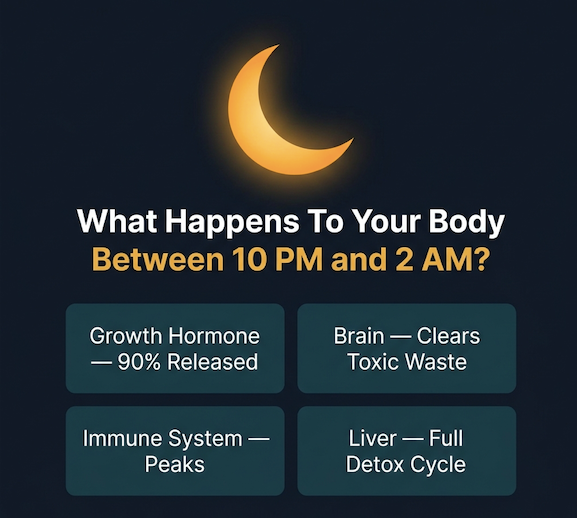
The Science of Deep Sleep —
What Happens to Your Body
Between 10 PM and 2 AM
These four hours are the most biologically valuable of your entire sleep period. Growth hormone peaks. Muscle and tissue rebuild. The immune system activates at full capacity. The brain clears metabolic waste. Every hour you spend awake past 10 PM is an hour your body cannot replace.
In This Article
- Why 10 PM to 2 AM Is Biologically Different
- Hour by Hour — What Your Body Is Doing
- The Four Hormones That Rule This Window
- What the Brain Does While You Sleep — The Glymphatic System
- The Immune System’s Night Shift
- The Real Cost of Staying Up Past Midnight
- Why Fajr and Early Sleep Are Aligned With Human Biology
- The 10 PM Protocol — How to Earn This Window
Why 10 PM to 2 AM Is Biologically Different
Not all sleep hours are equal. The architecture of human sleep is not uniform across the night — it is a structured biological programme divided into distinct phases, each serving specific restorative functions, and each occurring at a specific time within the 24-hour cycle that is governed by the circadian clock.
The hours between 10 PM and 2 AM represent the deepest, most physically restorative window of the entire sleep period for a person sleeping at the biologically appropriate time. This is when Slow Wave Sleep — the deepest stage of non-REM sleep, also called Stage N3 or deep sleep — is most abundant and most concentrated. It is during this window that the body’s most critical repair, regeneration, and maintenance processes occur — and these processes are time-locked to this window. They cannot simply be shifted to a later time by sleeping later.
“The body does not care what time the clock says. It cares what the light-dark cycle says. Sleep at 2 AM instead of 10 PM and you do not simply get the same sleep four hours later — you get a fundamentally different biological experience.”
The scientific basis for this window is the interaction between two biological systems: the sleep homeostatic drive — the pressure to sleep that builds during waking hours — and the circadian rhythm — the 24-hour internal clock that governs when each biological process occurs. Both systems converge most powerfully in the early part of the night, creating the conditions for the deepest, most restorative sleep. As the night progresses, the homeostatic drive dissipates and the circadian system shifts its output — deep sleep gives way to REM sleep, which dominates the early morning hours.
Hour by Hour — What Your Body Is Doing
For someone sleeping at approximately 10 PM and waking at 5–6 AM — aligned with the biological clock and the Fajr window — this is what is happening inside the body during each hour of the critical window.
The Sleep Gateway Opens
Melatonin — the darkness hormone — reaches its peak blood concentration approximately 2 hours after sunset or after light exposure ends. Core body temperature begins its descent — the 1–2°C drop required for sleep initiation. The brain’s default mode network quiets. Sleep pressure accumulated over the day reaches its maximum. For someone who has followed the evening light protocol — screens off, dim warm lighting — the transition from wakefulness to sleep at this time is natural, rapid, and smooth. The first sleep cycle begins.
The First Deep Sleep Cycle — Growth Hormone Surge
By 11 PM the brain has transitioned through light sleep (N1) and consolidated light sleep (N2) and entered the first episode of Slow Wave Sleep (N3 — deep sleep). This is the most physiologically important moment of the entire night. The pituitary gland releases the first and largest pulse of Human Growth Hormone (HGH) — a surge that accounts for approximately 70–80% of the entire day’s HGH secretion. Muscle fibres damaged during the day’s physical activity begin repair. Collagen synthesis accelerates. Bone density maintenance begins. Blood pressure drops to its nighttime low.
The Immune System Activates — Deep Repair Continues
By midnight the immune system is operating at maximum nocturnal intensity. T-lymphocytes and natural killer cells — the body’s primary defence against infection and abnormal cells — peak in both number and activity. Inflammatory cytokines are released to resolve micro-damage accumulated during the day. The lymphatic system accelerates its drainage. In the brain specifically, the glymphatic system — the brain’s waste clearance pathway — is at its most active, pumping cerebrospinal fluid through brain tissue to clear metabolic waste including amyloid beta and tau proteins associated with neurodegenerative disease. This is also when the second deep sleep cycle begins.
Liver Detoxification and Metabolic Reset
Traditional Chinese medicine identified 1–3 AM as the liver’s peak processing time long before modern science confirmed it. The liver’s circadian biology peaks in detoxification enzyme activity between 1 and 3 AM. Glycogen stores are regulated. Fat metabolism shifts — the body draws on fat stores as the primary energy source during deep sleep. Cholesterol is synthesised and transported. Insulin sensitivity is reset for the following day. A person awake at 1 AM — eating, scrolling, or working — is disrupting every one of these metabolic processes simultaneously.
The Biological Shift — Deep Sleep Gives Way to REM
Around 2 AM the balance of sleep architecture shifts. Deep sleep episodes become shorter. REM sleep episodes — associated with emotional processing, memory consolidation, and creative thinking — begin to lengthen. The body has completed its primary physical repair programme and transitions into the neurological and psychological restoration phase. The person who wakes at 2 AM — whether by alarm, phone notification, or a child — has completed the physical restoration window but is about to lose the psychological one. Both are necessary. Neither can replace the other.
The Four Hormones That Rule This Window
Four hormones dominate the biology of the 10 PM to 2 AM window. Understanding what each one does — and what disrupts it — explains why the consequences of missing this window are so wide-ranging and so difficult to compensate for later.
Human Growth Hormone (HGH)
Released in a single massive pulse at the onset of the first deep sleep episode — typically between 11 PM and midnight for a person sleeping at 10 PM. This pulse accounts for 70–80% of the total daily HGH secretion. HGH drives tissue repair, muscle protein synthesis, fat mobilisation, bone density maintenance, and immune cell production. It is not a bodybuilder’s supplement — it is the body’s master repair signal. Without it, everything degrades faster.
⚠ Late bedtime = missed HGH pulse = impaired physical recoveryMelatonin
Far more than a sleep signal — melatonin is a powerful antioxidant that protects cells from oxidative damage during the night. It synchronises the immune system’s nocturnal activity. It regulates the timing of deep sleep. It is also produced in the gut, where it governs intestinal motility during sleep. Melatonin production is exquisitely sensitive to light — even a brief exposure to blue-spectrum light at 10 PM can suppress the melatonin surge by 50% and delay its peak by 90 minutes, pushing the entire restorative window later and making it shallower.
⚠ Blue light at night = melatonin suppression = disrupted deep sleepCortisol — The Nighttime Nadir
Cortisol — the stress and alertness hormone — must be at its absolute lowest during the 10 PM to 2 AM window for deep sleep to occur properly. High cortisol and deep sleep are physiologically incompatible. Elevated cortisol suppresses both HGH release and immune activation. The factors that keep cortisol elevated at night: unresolved emotional stress, late eating, high-intensity exercise within 4 hours of sleep, stimulating screen content, and work emails. Each of these acts as a biological signal to the adrenal glands that the threat is not over — sleep must wait.
⚠ Elevated cortisol = suppressed HGH + disrupted deep sleepProlactin — The Immune Amplifier
Prolactin peaks during deep sleep in the early part of the night and acts as a powerful stimulator of immune function — amplifying the production and activity of natural killer cells and T-lymphocytes. It also suppresses the inflammatory response during the day — but allows controlled, targeted inflammatory repair during deep sleep. The person who consistently misses the 10 PM to 2 AM window has chronically low nocturnal prolactin — their immune system’s repair cycle is abbreviated every single night. The cumulative effect over months and years is measurably higher susceptibility to infection and slower recovery from illness.
⚠ Missed window = chronic immune repair deficitWhat the Brain Does While You Sleep — The Glymphatic System
The brain has a waste clearance system that was unknown to science until 2013 — when researchers at the University of Rochester published one of the most significant neuroscience discoveries of the decade. The glymphatic system is a network of channels surrounding the brain’s blood vessels through which cerebrospinal fluid is pumped — flushing the brain’s interstitial space and clearing the metabolic waste products that accumulate during waking neural activity.
The glymphatic system operates almost exclusively during sleep — and most actively during deep sleep. During wakefulness, the brain’s glial cells are swollen, leaving little space for fluid movement. During deep sleep, these cells shrink by up to 60%, dramatically expanding the interstitial space and allowing cerebrospinal fluid to flow freely through the brain tissue.
What the Glymphatic System Clears
The waste products the glymphatic system removes during deep sleep include amyloid beta — the protein that forms plaques in Alzheimer’s disease — and tau protein, which forms the neurofibrillary tangles also associated with Alzheimer’s and other dementias. Every night of insufficient or poorly-timed deep sleep results in a higher residual load of these proteins in the brain. This is not a theoretical risk for the distant future. It is a measurable accumulation that begins the first night of sleep disruption and compounds over years.
The Sleep-Alzheimer’s Connection
Research published in the journal Science in 2019 showed that a single night of sleep deprivation significantly increases amyloid beta accumulation in the human brain — particularly in the hippocampus and thalamus, regions critical for memory and cognitive function.
Chronic sleep disruption — consistently sleeping after midnight, fragmented sleep, or insufficient deep sleep — is now classified as a significant modifiable risk factor for Alzheimer’s disease. Not a minor association. A significant, independent risk factor — comparable in impact to physical inactivity.
The protection is simple: consistent, well-timed deep sleep during the 10 PM to 2 AM window gives the glymphatic system the conditions it needs to do its job. This is not optional maintenance. It is how the brain prevents its own progressive damage.
The Immune System’s Night Shift
The immune system operates on a precise circadian schedule — and its most active period is during deep sleep in the early part of the night. This is not incidental. It is a fundamental feature of immune biology that evolved over millions of years in organisms whose immune systems learned that the safest time to mount an inflammatory response is during rest — when the metabolic resources freed from movement and cognition can be redirected to repair and defence.
During the 10 PM to 2 AM window, natural killer cell activity increases approximately twofold compared to daytime levels. T-helper cells — which coordinate the immune response to infection — peak in their circulation and activity. Cytokines — the chemical messengers of the immune system — direct the repair of micro-damage, suppress viral replication, and clear damaged cells. This is also when the immune system consolidates its memory of recent vaccinations and infections — encoding the antibody response that will protect the body when it encounters the same pathogen again.
The Practical Consequence — Why You Get Sick After Poor Sleep
The connection between sleep deprivation and infection susceptibility is one of the most robustly documented findings in sleep medicine. A study published in the journal Sleep found that people sleeping fewer than 6 hours per night were 4.2 times more likely to develop a cold when exposed to the rhinovirus compared to people sleeping 7 hours or more. The mechanism is direct: insufficient deep sleep in the early part of the night means the immune system’s night shift is cut short. The repair is incomplete. The defence is lowered. The susceptibility is real — and measurable the very next day.
The Real Cost of Staying Up Past Midnight
The person who stays up until midnight, 1 AM, or 2 AM — whether working, watching, or scrolling — does not simply lose a few hours of sleep. They lose specific biological processes that cannot be rescheduled. The following table shows what is missed and what it costs.
| Biological Process | What Is Lost by Sleeping Late | Cumulative Effect Over Months |
|---|---|---|
| Growth Hormone Pulse | HGH pulse is time-locked to first deep sleep. Late sleep shifts the pulse but reduces its magnitude. Sleeping at 2 AM instead of 10 PM produces significantly less HGH. | Slower muscle recovery. Reduced fat metabolism. Accelerated biological ageing. Reduced bone density over time. |
| Glymphatic Brain Clearance | The brain accumulates amyloid beta and tau protein during waking hours. Every late night is another night of incomplete clearance — the waste load grows. | Cognitive decline. Memory impairment. Increased Alzheimer’s risk. Brain fog that worsens progressively. |
| Immune System Night Shift | Natural killer cell activity and T-cell peak are reduced. Cytokine repair signals are abbreviated. Immune memory consolidation is incomplete. | Higher infection rate. Slower recovery from illness. Reduced vaccine effectiveness. Increased inflammatory conditions. |
| Liver Detoxification Cycle | The liver’s peak detoxification window (1–3 AM) requires the body to be in rest and fasting state. Eating or drinking past midnight directly impairs this cycle. | Metabolic syndrome risk. Elevated triglycerides. Impaired insulin sensitivity. Fatty liver progression. |
| Cortisol Regulation | Late-night cortisol stays elevated — suppressing HGH, disrupting melatonin, and increasing next-day stress reactivity. | Chronic stress dysregulation. Adrenal fatigue symptoms. Increased anxiety and emotional instability. |
| Melatonin Antioxidant Activity | Late light exposure suppresses melatonin — reducing its antioxidant protection of cells. DNA repair during sleep is less effective. | Increased oxidative cell damage. Accelerated ageing at cellular level. Higher cancer risk over decades. |
Why Fajr and Early Sleep Are Aligned With Human Biology
The human circadian clock evolved over hundreds of thousands of years in an environment governed by one simple signal: the rising and setting of the sun. The biology of sleep — the melatonin cycle, the deep sleep window, the cortisol awakening response, the glymphatic clearance cycle — is calibrated to a world where darkness began at sunset and light returned at dawn. The person who sleeps at sunset and wakes at dawn is living in perfect alignment with every circadian process the human body has.
Fajr prayer time — occurring approximately 60–90 minutes before sunrise — falls precisely within the window where the circadian biology is transitioning from deep sleep to the cortisol pre-awakening response. The body is already preparing to wake. The HGH pulse has been completed. The immune night shift is winding down. The glymphatic clearance is at its tail end. Waking at Fajr does not cut short the critical window — it follows it.
The sleep pattern described in the Sunnah — sleeping shortly after Isha prayer, rising for Tahajjud in the later part of the night, then sleeping briefly before Fajr — aligns with what modern sleep science identifies as a bimodal sleep pattern. The first sleep captures the deep sleep window (10 PM–2 AM). The brief waking for Tahajjud occurs during the natural cortisol transition period (2–4 AM). The brief return to sleep captures the final REM-dominant cycles before dawn. This is not coincidence. This is the blueprint of human sleep biology expressed in prophetic practice.
The 10 PM Protocol — How to Earn This Window
The body does not simply enter the 10 PM to 2 AM deep sleep window because the clock says 10 PM. The window must be earned — by creating the biological conditions that allow the sleep system to function at its designed capacity. These are the six conditions required.
Darkness from 8:30 PM — The Melatonin Trigger
Dim all lights to warm tones after Maghrib. No overhead white lights. No phone screens. No television with blue-white light. The melatonin surge needs darkness to begin — and it needs 90 minutes of darkness before it reaches the level required for deep sleep initiation. If you start darkness at 8:30 PM, melatonin peaks at 10 PM. Sleep comes naturally. If you use screens until 10 PM, melatonin peaks at 11:30 PM at best — and the entire restorative window shifts later and becomes shallower.
Last Meal by 7 PM — Protect the Liver Window
The liver’s detoxification peak between 1 and 3 AM requires a fasting, resting body. Eating within 3 hours of sleep elevates core body temperature, raises insulin, increases digestive cortisol, and directly interferes with deep sleep quality. A light meal completed by 7 PM — or by Maghrib — allows full digestive processing before the sleep window opens and maximises the liver’s nocturnal detoxification capacity.
Resolve the Day Before Lying Down — Cortisol Clearance
Unresolved emotional tension, unfinished work tasks reviewed at night, and difficult conversations before sleep all activate the hypothalamic-pituitary-adrenal axis — keeping cortisol elevated when it needs to fall. The 20–30 minutes before sleep should contain nothing that activates the threat response. Quran recitation, quiet reflection, written planning for tomorrow — these lower cortisol. News, arguments, work emails, and social media comparison — these raise it.
Keep the Room Below 19°C — Core Temperature Must Fall
The body must reduce its core temperature by 1–2°C to enter and maintain deep sleep. A warm room prevents this drop — the person remains in lighter sleep stages and never achieves the deep sleep where HGH is released. In the Gulf region where air conditioning is essential, setting the bedroom to 17–19°C rather than 22–24°C produces a measurable improvement in deep sleep quantity. Even a ceiling fan that moves air over the body and assists evaporative cooling will help.
Complete Physical Exercise Before Asr — Not After Maghrib
Exercise raises core body temperature, elevates cortisol, and activates the sympathetic nervous system. All of these are the opposite of what deep sleep requires. Exercise completed before Asr — in the late afternoon — has time to fully reverse before the sleep window opens. Exercise after Maghrib delays sleep onset and reduces deep sleep quality, even if the person subjectively feels tired. The fatigue from late exercise is real — but it is the wrong kind of tiredness for deep sleep.
Drink 400ml of Water After Isha — Pre-Sleep Hydration
The body loses 400–600ml of water during sleep through respiration and perspiration. Mild dehydration impairs deep sleep quality — the body cannot fully lower blood pressure and heart rate when blood volume is below optimal. Drinking a full glass of water after Isha prayer — before the sleep window opens — ensures adequate hydration for the full night without causing disruptive bathroom visits in the critical early hours.
Four Hours That Cannot Be Replaced
The window between 10 PM and 2 AM is not a preference or a tradition. It is a biological reality encoded into the circadian system over hundreds of thousands of years of human evolution. Growth hormone, melatonin, the glymphatic system, the immune night shift, the liver detoxification cycle — all of them peak, operate, and depend on a body that is in deep sleep during these specific hours.
The person who consistently earns this window — who enters deep sleep by 10 PM through the preparation that makes it possible — is investing in physical recovery, cognitive protection, immune strength, metabolic health, and longevity every single night. The person who consistently misses it — who scrolls until midnight, eats late, and sleeps after the window has closed — is making a withdrawal from every one of those accounts, every single night, compounding over years.
This is not about discipline for its own sake. This is about understanding what your body is designed to do — and giving it the conditions to do it. Sleep early. Sleep well. Wake for Fajr. The biology agrees with the Sunnah completely.
Begin Your 120-Day Transformation
Download the free 7-Day Starter Guide at Shifa120.com and build the evening routine that unlocks the deep sleep window — starting tonight.
Start at Shifa120.com →