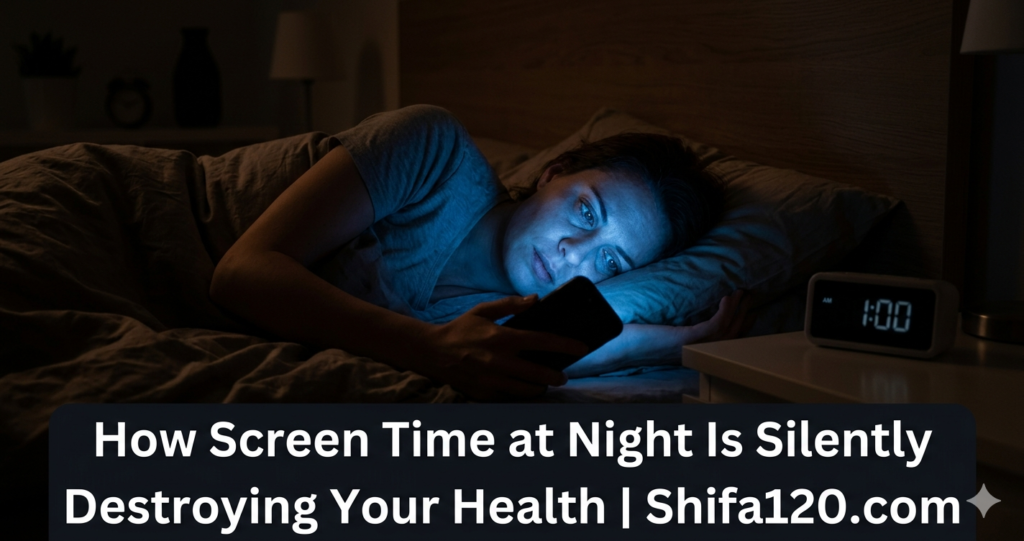
You brush your teeth. You turn off the lights. You lie down in bed.
And then you pick up your phone.
Thirty minutes later you are still scrolling. An hour later your eyes are heavy but your mind is racing. You finally put the phone down at midnight. You set your alarm for six. You tell yourself you will catch up on sleep this weekend.
You have been telling yourself that for months.
What is happening to your body during those hours on the screen is not just tiredness the next morning. It is a slow, compounding damage to your sleep, your metabolism, your hormones, your mental health, and your long-term disease risk — and most people have no idea it is happening.
The Science Behind Why Night Screens Are So Harmful
Your body runs on a 24-hour internal clock called the circadian rhythm. This clock controls when you feel awake, when you feel sleepy, when your body repairs itself, when hormones are released, and when your digestion slows down for rest.
The primary signal that controls this clock is light — specifically blue light, which is the dominant wavelength emitted by phone screens, tablets, laptops, and televisions.
When your eyes detect blue light, a signal travels to a tiny area of your brain called the suprachiasmatic nucleus, which then suppresses the release of melatonin — the hormone that tells your body it is time to sleep.
In natural conditions, blue light comes from the sky. When the sun sets, blue light disappears, melatonin rises, and your body begins preparing for sleep. This system has worked for hundreds of thousands of years.
When you look at a phone screen at 10pm, your brain receives a signal that is almost identical to midday sunlight. Melatonin is suppressed. Your body does not begin its sleep preparation. You lie in bed with a brain that biologically believes it is still the middle of the afternoon.
This is not a theory. It is documented, replicated science.
What Happens to Your Body Every Night You Do This
Your Sleep Quality Collapses
Melatonin suppression means you take longer to fall asleep, you spend less time in deep sleep (the stage where physical repair happens), and you spend less time in REM sleep (the stage where memory consolidation and emotional processing happen).
You may sleep eight hours and still wake up exhausted — because the quality of those hours has been compromised at a biological level.
Your Cortisol Rhythm Is Disrupted
Cortisol — your primary stress hormone — should be low at night and peak in the morning to help you wake up and feel alert. Screen time at night elevates cortisol at the wrong time. You feel wired when you should be winding down. You feel groggy in the morning when cortisol should be rising naturally.
Over weeks and months, this disrupted cortisol pattern contributes to chronic stress, anxiety, and adrenal fatigue.
Your Metabolism Slows and Weight Increases
Sleep deprivation — even mild, chronic sleep deprivation from late screens — dysregulates two critical hunger hormones: ghrelin (which increases appetite) and leptin (which signals fullness). When these hormones are disrupted, you eat more, crave higher-calorie foods, and your body stores more fat.
Research published in the American Journal of Clinical Nutrition found that sleep-deprived subjects consumed significantly more calories the following day, with a particular increase in late-night snacking — which compounds the metabolic damage further.
Your Immune System Is Weakened
The majority of immune repair and immune memory consolidation happens during deep sleep. When you consistently reduce your deep sleep through night screen use, your immune system operates at reduced capacity. You get sick more frequently. Recovery takes longer. Your body’s ability to fight long-term disease — including cancer — is measurably reduced.
Your Mental Health Deteriorates
The content you consume at night matters as much as the light itself. Social media at night exposes you to comparison, conflict, news, and stimulation at the exact moment your nervous system needs to be calming down. Studies consistently show associations between evening social media use and increased rates of anxiety, depression, and negative self-image — particularly in younger adults.
The blue light suppresses melatonin. The content activates the stress response. Together, they create a pattern that quietly erodes mental wellbeing over time.
Your Eyes Are Under Constant Strain
Extended screen use causes digital eye strain — dry eyes, blurred vision, and headaches. At night, when your eyes are already fatigued from the day, the damage compounds. Long-term, chronic blue light exposure has been linked to accelerated macular degeneration — irreversible damage to the central vision of the eye.
The Compounding Effect — Why One Bad Night Becomes a Pattern
This is the part most people underestimate.
One late night on your phone does not destroy your health. But your body does not fully recover from one night of disrupted sleep before the next disruption arrives. The damage compounds.
After two weeks of sleeping six hours instead of eight, cognitive performance declines to the level of someone who has been awake for 24 hours straight — and the person experiencing this decline does not notice it because the gradual degradation feels normal.
After months of this pattern, the metabolic, hormonal, and immune consequences become structural. They do not disappear with one good night of sleep. Recovery takes weeks of consistent habit change.
The 120-Day Principle — Why This Takes Time to Reverse
At Shifa120, our foundation is the understanding that genuine health transformation takes time — approximately 120 days of consistent practice before new habits become biological defaults.
This is not discouraging. It is liberating.
It means you do not need to be perfect tonight. You need to be consistent over the next four months. Small daily improvements in your evening habits — starting the screen-off process 30 minutes earlier each week, building a real wind-down routine, protecting your sleep environment — compound into a measurable transformation in your energy, mood, metabolism, and long-term health.
Practical Steps to Protect Your Health Starting Tonight
Step 1 — Set a hard screen cutoff time. Choose a time — ideally 60 to 90 minutes before your target sleep time — after which no screens are used. Start with 30 minutes if 90 feels impossible. Build from there.
Step 2 — Enable night mode and reduce brightness. Night mode reduces blue light emission. It does not eliminate it, but it reduces the melatonin suppression. Use it from sunset onward as a minimum standard.
Step 3 — Charge your phone outside the bedroom. This single change removes the temptation entirely. Use an alarm clock. Your phone does not need to be within reach while you sleep.
Step 4 — Replace the screen with something that calms. Reading a physical book, light stretching, journaling, or quiet conversation are all replacements that actively support sleep preparation rather than fighting it.
Step 5 — Protect the first and last 30 minutes of your day. No screens for the first 30 minutes after waking — let cortisol rise naturally. No screens for the last 30 minutes before sleep — let melatonin rise naturally. These two windows have an outsized effect on your entire daily energy cycle.
Step 6 — Be consistent, not perfect. Missing one night is not failure. Returning to the habit the next night is what matters. Consistency over 120 days is the goal — not perfection tonight.
The Health You Are Protecting Is Worth More Than the Scroll
Every notification that pulls you to your phone at night is competing with your sleep, your hormones, your metabolism, your immune system, your mental health, and your long-term wellbeing.
The scroll gives you nothing that cannot wait until morning.
Your health cannot wait.
Start tonight. Put the phone down 30 minutes earlier than usual. Do it again tomorrow. And the night after. In 120 days, you will not recognise the difference in how you feel.
That transformation starts with one decision — tonight.
This post is part of the Shifa120 wellness transformation programme. Learn more at shifa120.com.