Why Most People Fail
at Building Habits —
and the One Fix That Works
The reason your habits fail is not your willpower, your discipline, or your motivation. It is a specific structural mistake that almost everyone makes — and it has a single, precise fix.
In This Article
- The Lie We Tell Ourselves About Why Habits Fail
- The Five Real Reasons Habits Fail
- The One Fix — Identity-Based Habit Building
- How Identity Change Actually Works
- Practical Examples — Transforming Outcome Goals into Identity Goals
- The Islamic Framework of Identity — Why This Is Not New
- Applying the Fix Over 120 Days
- Conclusion — You Are Not Trying to Do Something. You Are Becoming Someone.
At some point — probably more than once — you have set out to build a habit with genuine commitment. You were going to exercise every morning. You were going to stop eating sugar. You were going to wake up earlier, read more, spend less time on your phone. You meant it. You started. And then, within weeks — sometimes days — it was gone.
And the story you told yourself was probably some version of the same story most people tell: “I just don’t have enough discipline.” “I’m not that kind of person.” “I’ll try again when things calm down.”
Here is what the research actually shows: the reason habits fail has almost nothing to do with discipline, motivation, or personal character. It has everything to do with how the habit was framed from the very beginning. And the fix — once you understand it — is not about trying harder. It is about thinking differently.
The Lie We Tell Ourselves About Why Habits Fail
When a habit fails — when the morning run stops happening, when the Quran recitation drops off, when the healthy eating lasts three weeks and then disappears — most people reach for the same explanation: willpower. They did not want it badly enough. They were not disciplined enough. They were not the type of person who does these things.
This explanation is not just wrong. It is actively harmful. Because it locates the problem in a fixed personal quality — discipline or willpower — that the person believes they either have or do not have. And if you believe the problem is your character, the logical conclusion is that you cannot fix it. The habit was always going to fail because you are the kind of person who fails at habits.
“The problem is not your willpower. The problem is that you are trying to use willpower to do something that does not yet feel like who you are. And willpower is never strong enough to sustain that for long.”
The research on behaviour change is unambiguous on this point. Willpower is a finite resource — it depletes with use throughout the day, it is reduced by stress, poor sleep, and decision fatigue, and it is simply not designed to be the primary driver of long-term behaviour change. Any habit that depends on willpower to happen will stop happening as soon as the willpower runs low. Which is daily, for everyone.
So the question is not how to generate more willpower. The question is how to build habits that do not require willpower at all — habits that happen because they feel like an expression of who you are, rather than a constant battle against who you are.
The Five Real Reasons Habits Fail
Before we arrive at the fix, it is worth understanding precisely why habits fail. There are five structural reasons — and every failed habit can be traced to at least one of them.
Outcome-focused framing
The habit is built around a result — “I want to lose 10 kilos,” “I want to read 20 books this year.” When the result feels distant or uncertain, motivation disappears. The habit has no foundation except the hoped-for outcome, which may be months away.
Too large too fast
The initial commitment is too demanding. Sixty minutes of exercise daily from day one. Complete dietary overhaul from tomorrow. The brain registers the size of the commitment as threatening and generates resistance that grows stronger over time until the habit collapses.
No environmental design
The habit depends entirely on remembering to do it and feeling motivated to do it — no physical cues, no anchors to existing routines, no environmental changes that make the behaviour easier or the default. When life gets busy, the habit simply disappears from the schedule.
No recovery protocol
One missed day is treated as failure. The all-or-nothing framing means a single disruption — illness, travel, a bad night — breaks the chain permanently. The person abandons the habit rather than simply resuming it the next day.
Identity mismatch
The deepest and most common reason. The habit does not feel like who the person is. Every time they perform it, there is a subtle internal friction — “this is not really me, this is something I’m making myself do.” That friction accumulates. Eventually the habit stops.
Motivation dependency
The habit is built on the assumption that motivation will be consistently available. When motivation fluctuates — as it always does — the habit fluctuates with it. A habit that only runs when motivation is high will run for approximately two weeks.
Notice that four of these six failure causes are structural problems — problems with how the habit was designed. Only motivation dependency involves an internal state. And even motivation dependency is a structural problem at its root: a habit built on motivation was never designed to survive without it.
The One Fix — Identity-Based Habit Building
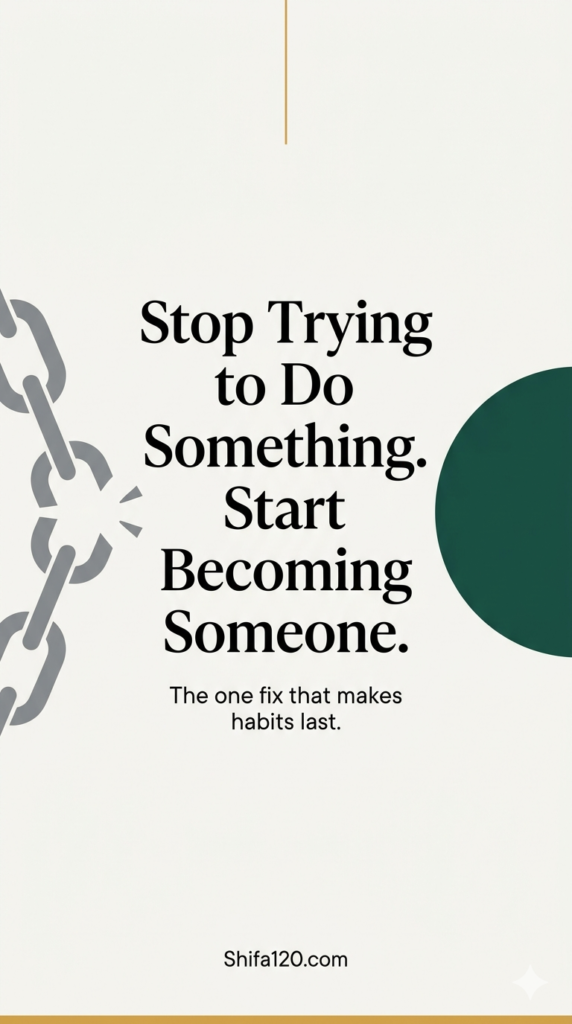
Stop trying to achieve an outcome.
Start becoming a person.
Every lasting habit change begins not with a goal but with an identity shift. Not “I want to exercise” but “I am someone who moves their body every day.” Not “I want to read Quran” but “I am someone who begins every day with the word of Allah.” The habit is not something you do. It is something you are.
This is the central insight of identity-based habit building — a framework developed primarily through the research of James Clear and supported by decades of behaviour change science. The insight is simple but its implications are profound: the most reliable predictor of whether a habit will last is not how motivated the person is, but whether the habit is consistent with how the person sees themselves.
When a habit is consistent with your identity — when exercising feels like something a person like you does, rather than something you are forcing yourself to do — the habit generates its own motivation. You do it because not doing it would feel inconsistent with who you are. The friction reverses direction: instead of friction against performing the habit, you experience friction against skipping it.
This reversal is everything. It is the difference between a habit that requires willpower to maintain and a habit that requires willpower to abandon. Identity-based habits are self-reinforcing. Outcome-based habits are self-depleting.
How Identity Change Actually Works
The natural question is: how do you change your identity? If you have never consistently exercised, how do you become “a person who exercises”? If you have never maintained a regular Quran recitation practice, how do you become “a person who reads Quran every morning”?
The answer is counterintuitive. Identity does not precede behaviour. It follows from it. You do not first become a person who exercises and then start exercising. You start exercising — even once, even briefly — and that single act is a vote for the identity you want to build. Every subsequent act is another vote. Over time, the accumulation of votes becomes a conviction: this is who I am.
The Voting Metaphor
Think of your identity as a democratic election that is always in progress. Every action you take is a vote for a particular type of person. A person who gets up when the alarm sounds casts a vote for being someone who keeps their commitments. A person who drinks water before coffee casts a vote for being someone who takes care of their body. A person who opens the Quran for three minutes after Fajr casts a vote for being someone whose faith is lived daily, not just believed intellectually.
No single vote wins the election. But over 120 days of consistent voting — of small, repeated actions that point in the same direction — the election is decided. The identity is not claimed. It is earned, vote by vote.
✗ Outcome-Based Thinking
- “I want to lose weight”
- “I want to be more productive”
- “I want to read more Quran”
- “I want to wake up earlier”
- “I want to stop eating sugar”
- “I want to exercise regularly”
✓ Identity-Based Thinking
- “I am someone who eats to nourish”
- “I am someone who works with focus”
- “I am someone who begins with Allah”
- “I am someone who owns the morning”
- “I am someone who eats real food”
- “I am someone who moves daily”
The difference between these two columns is not just language. It is the entire psychological architecture of the habit. The left column describes a destination — something to arrive at, something that may or may not happen. The right column describes a person — someone who already exists, someone whose habits are simply expressions of who they are.
Practical Examples — Transforming Outcome Goals into Identity Goals
Here is how identity-based framing transforms the most common habit failures into durable practices. For each example, notice how the internal experience of the habit changes when the framing shifts.
The Morning Walk
Outcome framingQuran Recitation After Fajr
Outcome framingEating Real Food
Outcome framingWaking Before 5 AM
Outcome framingIn each case, the habit itself is identical. The behaviour is the same. But the relationship to the behaviour is completely different. The outcome-based framer is fighting against themselves to perform the habit. The identity-based framer would be fighting against themselves to skip it. Same habit. Opposite internal experience. Completely different long-term result.
The Islamic Framework of Identity — Why This Is Not New
The concept of identity-based behaviour change is, in the Western behavioural science tradition, relatively recent — popularised primarily in the last decade through the work of researchers like James Clear and BJ Fogg. But for the practising Muslim, this framework is not new at all. It is embedded in the foundational concepts of Islamic practice.
Islam does not describe prayer as something a Muslim does to achieve a goal. It describes prayer as something a Muslim is — it is the expression of the Muslim’s identity as a servant of Allah. The five daily prayers are not a productivity habit. They are the rhythmic expression of who the believer is, five times every day, regardless of how they feel, regardless of how motivated they are, regardless of whether they are in the mood.
This is precisely the structure of identity-based habit building. The prayer does not depend on motivation because the motivation is not external — it is internal and structural. The Muslim prays because they are a Muslim, not because they feel like praying today. The identity makes the behaviour non-optional.
Taqwa as Identity Architecture
The Islamic concept of taqwa — often translated as God-consciousness or piety — is, at its core, an identity concept. The muttaqi — the person of taqwa — is not described as someone who occasionally performs good deeds when motivated. They are described as someone whose entire orientation toward life is shaped by awareness of Allah. Their choices, their habits, their daily routines are all expressions of this identity.
When the Quran describes the characteristics of the believers — those who establish the prayer, give from what they have been given, fulfil their trusts and covenants — it is describing identity, not a to-do list. The habits follow from the identity. The identity is primary.
- The believer who prays is not performing a task — they are expressing who they are
- The believer who gives in charity is not checking a box — they are being themselves
- The believer who wakes for Tahajjud is not fighting their nature — they are fulfilling it
The Shifa120 approach to health transformation is built on exactly this foundation: the most durable health habits are not things you do. They are expressions of who you are becoming.
Applying the Fix Over 120 Days
Understanding identity-based habit building is one thing. Applying it over 120 days — through the inevitable difficult mornings, the motivation valleys, the competing demands of work and family and life — requires a specific approach. Here is how it unfolds.
Declare the Identity — Then Cast the First Votes
The declaration phaseWrite down — in a single sentence — the identity you are building. Not the outcome you want. The person you are becoming. “I am someone who begins every day with intention.” “I am someone who moves their body every morning.” “I am someone whose health is a daily practice, not a January resolution.” Then cast the first votes for that identity — small, consistent, daily acts that point in its direction. The acts are not the destination. They are evidence of who you already are becoming.
Accumulate Evidence — Survive the Motivation Valley
The evidence-building phaseBetween days ten and forty, the initial novelty fades and the motivation valley begins. This is where outcome-based habits collapse — the goal feels distant, the effort feels unrewarding, and the motivation to continue is genuinely low. But for the identity-based habit builder, this phase is different. The question is not “am I motivated to exercise today?” but “is skipping this consistent with who I am?” The identity question is far more durable than the motivation question. Keep casting votes. The evidence accumulates even when you cannot feel it accumulating.
The Identity Begins to Solidify
The consolidation phaseAround day forty to fifty, something changes. The habit begins to feel less like a choice and more like an expression. Getting up and drinking water before coffee is no longer a decision — it is just what you do. The morning walk is not something you have to motivate yourself to do — missing it starts to feel wrong. This is the identity beginning to solidify. The votes you have cast over forty days are adding up to a conviction. You are not just doing these things. You are becoming someone who does these things.
The Identity Is Who You Are
The identity phaseBy day eighty to ninety, the identity shift is largely complete for the habits you have been practising consistently. You are no longer building these habits. You have them. They are part of how you see yourself. On day 120, when you look back at the person who began this journey, the difference is not primarily in the habits performed — it is in the person performing them. The identity has changed. And because the identity has changed, the habits are no longer fragile. They are structural. They belong to who you are.
The One Question That Replaces Willpower
Every morning, when the alarm sounds and you are deciding whether to get up and begin your ritual, replace the willpower question with the identity question.
Instead of: “Do I feel motivated to do this today?”
Ask: “Is this what a person like me does?”
If the answer is yes — and over 120 days it will increasingly be yes — the decision is already made. You are not gathering the willpower to begin. You are simply being who you are.
You Are Not Trying to Do Something.
You Are Becoming Someone.
The reason most people fail at building habits is not because they are weak, undisciplined, or lacking in motivation. It is because they are trying to achieve outcomes with willpower — and willpower is not designed for that job. Outcomes are destinations. Willpower is not a vehicle. It is a temporary fuel that runs out.
The one fix that changes everything is also the simplest: shift the question from what you want to accomplish to who you want to become. Define the identity. Cast votes for it every day through small, consistent, deliberate actions. Let the evidence accumulate. Let the identity solidify. And watch the habits that once required constant willpower become expressions of who you naturally are.
Over 120 days, this shift produces something that no outcome-focused habit plan can produce: a person who has genuinely changed — not just someone who has performed a set of behaviours for four months and returned to their old life, but someone whose identity is different. Someone for whom the healthy choice, the intentional morning, the daily movement, the Quranic recitation, is not an achievement. It is simply Tuesday.
That is what the Shifa120 method is built for. Not 120 days of effort. 120 days of becoming.
Begin Your 120-Day Identity Transformation
Download the free 7-Day Starter Guide at Shifa120.com and take your first step toward becoming the person whose habits you want to have.
Start at Shifa120.com →