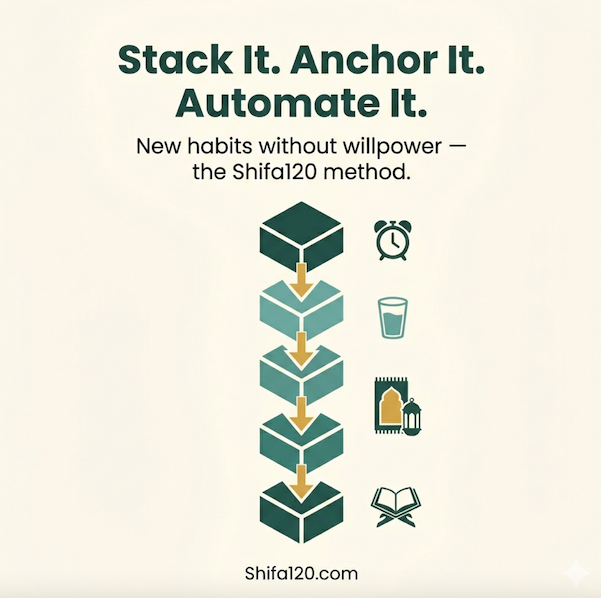
The Habit Stacking Method —
How to Add New Habits
Without Willpower
You already have dozens of automatic habits running every day. Habit stacking connects new behaviours to those existing anchors — so the new habit happens automatically, without a decision, without motivation, and without willpower.
In This Article
- The Problem With Adding New Habits One at a Time
- What Is Habit Stacking?
- The Exact Formula
- Why Habit Stacking Works — The Neuroscience
- The Five Rules of Effective Habit Stacking
- Real Examples — Morning, Health, and Spiritual Practice
- The Three Stacking Mistakes That Break the Chain
- Building Your Complete 120-Day Habit Stack
- Conclusion
Every morning, without thinking, you do the same things in roughly the same order. You wake up. You go to the bathroom. You make tea or coffee. You check your phone. You get dressed. These behaviours happen automatically — not because you decide to do them, not because you feel motivated, but because they are deeply encoded routines that run on autopilot.
This automatic quality is the most valuable resource in habit building — and almost nobody uses it deliberately. Habit stacking is the method that uses your existing automatic behaviours as launch pads for new ones. Instead of trying to add a new habit from scratch — which requires willpower, motivation, and conscious effort every single time — you attach the new habit to something you already do automatically. The existing habit becomes the trigger. The new habit becomes the response. And over time, the new habit becomes automatic too.
This is not a motivational technique. It is a structural one. It works not because it makes you feel more motivated or more disciplined — it works because it removes the need for motivation and discipline entirely.
The Problem With Adding New Habits One at a Time
The conventional approach to building a new habit treats it as an isolated behaviour that must be inserted into the day through willpower and conscious decision-making. You decide you want to drink more water in the morning. You try to remember to do it. Some mornings you remember. Some mornings you are in a rush and it does not happen. Some mornings you think about it after your first coffee and decide it does not matter today. Within two weeks, the habit has not formed — because it was never anchored to anything automatic. It was floating freely in the day, depending on memory and motivation to appear.
The deeper problem is cognitive load. Every new habit that is not anchored to an existing automatic behaviour requires a conscious decision every single time it is supposed to happen. That decision consumes mental energy. And mental energy — decision-making capacity — is finite. The more decisions you have to make, the faster it depletes. By the afternoon, the capacity for effortful new behaviour is significantly reduced from what it was in the morning.
“You do not need more willpower to build new habits. You need to stop relying on willpower entirely. Habit stacking builds the trigger into the environment so the decision has already been made.”
Habit stacking solves the cognitive load problem at its root. When a new habit is attached to an existing automatic behaviour, it inherits that behaviour’s automaticity. The trigger is already firing — it fires every day without a decision. And when the trigger fires, the new habit is attached to it, so the new habit fires too. No separate decision required. No willpower consumed. The habit simply happens because the thing before it happened.
What Is Habit Stacking?
Habit stacking is a behaviour change technique developed and popularised through the research of BJ Fogg at Stanford University and expanded by James Clear in his work on habit formation. The core insight is simple: every existing habit is a potential trigger for a new one. By deliberately linking new behaviours to existing automatic ones — stacking them in sequence — you create a chain of habits that runs automatically, each one triggering the next.
The term “stacking” captures the architecture precisely. You are not replacing existing habits. You are not reorganising your day. You are adding new behaviours on top of existing anchors — building vertically on foundations that are already stable.
In Islamic practice, this concept is embedded in the structure of daily life without the terminology. The five daily prayers are anchored to specific times of day — Fajr at dawn, Dhuhr at midday, Asr in the afternoon, Maghrib at sunset, Isha at night. Each prayer is a fixed anchor. Around each anchor, the practising Muslim builds additional behaviours — dhikr after prayer, Quran recitation, du’a, voluntary prayers before or after. The Islamic daily structure is, at its architectural core, a sophisticated habit stack built around five daily anchors. The Shifa120 method uses this same architecture for health and wellness transformation.
The Exact Formula
I will [NEW HABIT].”
The formula has two components — and both must be specific for the stack to work reliably.
The existing habit must be something you already do automatically every single day — not something you usually do, not something you try to do, but something that happens without conscious thought. Getting out of bed. Making your first drink. Performing wudu. Sitting down at your desk. Putting on shoes. These are reliable anchors because they are non-negotiable — they happen regardless of how you feel.
The new habit must be specific enough that there is no ambiguity about what you are supposed to do. “I will exercise” is not specific enough. “I will do ten bodyweight squats” is specific. “I will read” is not specific enough. “I will read three pages of my book” is specific. Specificity removes the need for in-the-moment decision-making — another form of willpower consumption that habit stacking eliminates.
Here are five examples of the formula applied correctly:
Why Habit Stacking Works — The Neuroscience
Habit stacking is not just a productivity framework. It is grounded in the neuroscience of how the brain forms and retrieves automatic behaviours — specifically, the mechanism of associative learning and the role of the basal ganglia in habit storage.
Associative Learning and the Brain
The brain stores habits as context-dependent responses — the habit is encoded not just as an action but as an action-in-context. The context — the preceding event, the location, the time of day — becomes the trigger that retrieves the habit from memory. When you consistently perform behaviour B immediately after behaviour A, the brain’s associative learning system creates a link between them. Over time, the occurrence of A automatically retrieves B — you do not need to decide to do B. A happening is sufficient.
This is precisely what happens with existing automatic habits. Your morning coffee is triggered by reaching the kitchen. Your phone check is triggered by sitting down. Habit stacking deliberately creates new associative links — new connections between existing reliable triggers and new desired behaviours. The new behaviour is encoded in the context of the existing trigger and gradually inherits its automaticity.
The Implementation Intention Effect
Research by psychologist Peter Gollwitzer at New York University has extensively documented what he calls the implementation intention effect — the dramatic increase in behaviour follow-through that occurs when a person specifies not just what they intend to do but exactly when and where they will do it. The habit stacking formula “After I [X], I will [Y]” is an implementation intention. Research consistently shows that people who form implementation intentions are two to three times more likely to follow through on intended behaviours than those who set goals without specifying the triggering context.
The mechanism is neurological: the specification of a triggering context creates a prospective memory cue — the brain essentially flags the trigger event so that when it occurs, the intended behaviour is automatically retrieved. The intention does not need to be consciously maintained because the retrieval is automatic once the implementation intention is formed. The habit stacking formula is, in neurological terms, a precisely targeted implementation intention.
The Role of the Basal Ganglia
As habits become established through repetition, the brain progressively transfers control of the behaviour from the prefrontal cortex — the conscious, effortful, decision-making part of the brain — to the basal ganglia, which executes automatic sequences without conscious involvement. This transfer is what makes a habit feel effortless. Habit stacking accelerates this transfer for new behaviours by embedding them in sequences that the basal ganglia is already managing. The new behaviour is encoded alongside the existing automatic sequence, allowing the basal ganglia to incorporate it into its automated execution.
The Five Rules of Effective Habit Stacking
The Anchor Must Be Truly Automatic
The existing habit you choose as your anchor must be something that happens every single day without exception and without conscious effort. Wudu, prayer, making your first drink, putting on shoes — these are reliable anchors. “After I finish my workout” is not a reliable anchor if your workout does not happen every day. If the anchor is inconsistent, the stack is inconsistent. Choose anchors that are as close to non-negotiable as possible.
The New Habit Must Be Specific and Brief
The new habit in your stack must be specific enough that there is no ambiguity — “I will drink one full glass of water” not “I will drink more water.” And it must be brief enough that it does not disrupt the flow of the existing routine. Starting with habits of two to five minutes maximum allows the stack to feel natural rather than like an interruption. Extend the duration only after the habit feels automatic — not before.
The Stack Must Flow Naturally
The new habit should follow naturally from the existing anchor — in terms of physical location, timing, and context. “After I finish wudu, I will do twenty minutes of exercise” does not flow naturally — wudu is preparation for prayer, not a trigger for exercise. “After I finish wudu, I will begin Fajr prayer” flows naturally. “After Fajr, I will sit in dhikr for five minutes” flows naturally. “After dhikr, I will drink a glass of water” flows naturally. Build stacks that respect the natural sequence of your existing routine.
Add One New Habit at a Time
The most common habit stacking mistake is adding too many new habits simultaneously. Each new habit needs two to four weeks to begin developing automaticity before the next is added. Adding three habits to a stack at once means none of them has the time to become automatic before the next is introduced. The result is a stack that feels effortful throughout and eventually collapses. Add one new habit. Wait until it feels natural. Then add the next.
Write the Stack Down — Once
Write your habit stack as a sequence of “After I [X], I will [Y]” statements — physically written, in a notebook or on a card. This act of writing is not a daily review ritual. It is a one-time implementation intention formation. Research shows that the act of writing a specific behavioural intention significantly increases the probability of follow-through. Write it once, place it somewhere visible for the first two weeks, and then trust the neurological encoding process to take over.
Real Examples — Morning, Health, and Spiritual Practice
Here is how habit stacking applies across the three dimensions of the Shifa120 transformation — morning routine, physical health, and spiritual practice. These are not aspirational examples. They are practical sequences built on real anchors that most people already have.
The Morning Stack — Built on Wudu and Fajr
Complete Morning Habit Stack
Notice what this stack achieves: seven behaviours — hydration, wudu, prayer, Quran, movement, gratitude, intention-setting — all flowing automatically from a single anchor: feet on the floor. No separate decision is made for any of them. Each one triggers the next. The total time is under sixty minutes. And after thirty days of consistent practice, the entire sequence runs on its own internal momentum.
The Health Stack — Built on Mealtimes
Mealtimes are among the most reliable daily anchors — they occur at roughly predictable times, they are associated with specific physical locations, and they are surrounded by existing automatic behaviours. This makes them excellent anchors for health habit stacks:
- Before breakfast: After I sit down for breakfast → I will drink one glass of water before eating anything
- After lunch: After I finish lunch → I will stand up and walk for five minutes rather than sitting immediately
- Before dinner: After I enter the kitchen to prepare dinner → I will prepare my water bottle for tomorrow morning
- After dinner: After I finish dinner → I will write three specific things I am grateful for today
- Before sleep: After I get into bed → I will put my phone face-down and read three pages of a book
The Spiritual Stack — Built on Prayer Times
For the practising Muslim, the five daily prayers are the most powerful habit stack anchors available — they are deeply established, non-negotiable, and occur at predictable intervals throughout the day. Building additional spiritual and wellness practices around these anchors is both neurologically optimal and spiritually aligned:
- After Fajr: After Fajr salaam → five minutes of morning dhikr → three pages of Quran → water
- After Dhuhr: After Dhuhr salaam → one minute of intention review → return to work
- After Asr: After Asr salaam → five minutes of movement or stretching
- After Maghrib: After Maghrib salaam → begin final meal preparation
- After Isha: After Isha salaam → gratitude journal → screen-off → prepare for sleep
The Three Stacking Mistakes That Break the Chain
Mistake 1 — Choosing a Weak Anchor
The most common habit stacking failure is anchoring a new habit to an existing behaviour that is not as automatic as assumed. “After I exercise in the morning” seems like a good anchor — until the exercise does not happen, and the stacked habit disappears with it. “After I drink my morning coffee” seems reliable — until a morning comes without coffee, and the stack collapses. Choose anchors that are as close to physically non-negotiable as possible. Waking up. Getting out of bed. Wudu. These are the strongest possible anchors because they require the absence of a catastrophic event to miss.
Mistake 2 — Stacking Too Many Habits Too Quickly
Habit stacking can make building multiple habits feel deceptively simple — which leads people to stack five, six, or seven new behaviours onto an anchor simultaneously. The initial days feel manageable. By week two, the accumulated cognitive load of executing multiple not-yet-automatic behaviours in sequence is significant. By week three, the stack is abandoned. One new habit in the stack at a time. Two weeks minimum before the next is added. Patience is the ingredient that makes stacking work at scale.
The Specific Warning for Ambitious Stackers
If you are reading this article and already mentally designing a ten-habit stack for tomorrow morning — stop. Start with one. The person who adds one habit to their Fajr stack and maintains it perfectly for thirty days is building something real. The person who adds eight habits simultaneously and abandons them all by week three has built nothing. Start with one. It feels insufficient. It is not.
Mistake 3 — Making the New Habit Too Long or Too Demanding
A new habit in a stack should feel almost absurdly easy in its initial form. Three pages of Quran, not thirty. One glass of water, not three. Five minutes of movement, not thirty. Five minutes of gratitude, not twenty. The purpose of the initial version of the habit is not to produce results — it is to establish the neural association between the anchor and the new behaviour. Once that association is encoded, the duration and intensity can be extended. But in the first two to four weeks, the new habit must be so small that the brain offers no resistance to performing it.
Building Your Complete 120-Day Habit Stack
Here is the exact sequence for building a complete, automatic habit stack over 120 days — starting from wherever you are right now.
The 120-Day Stacking Schedule
- Days 1–14: Fix your wake time. Add one habit only — one glass of water immediately after feet hit the floor. Nothing else. This feels too simple. Do it anyway.
- Days 15–28: Water is beginning to feel automatic. Add the second habit — wudu immediately after water. The sequence is now: wake → water → wudu.
- Days 29–42: Add Quran recitation for five minutes after Fajr. Sequence: wake → water → wudu → Fajr → Quran.
- Days 43–56: Add movement after Quran. Sequence: wake → water → wudu → Fajr → Quran → 20-minute walk.
- Days 57–70: Add gratitude journal after walk. Sequence adds: → write three gratitude items + one intention.
- Days 71–84: Add an evening habit — gratitude journal after dinner if not already in morning stack. Or begin a screen-off protocol thirty minutes before sleep.
- Days 85–120: Consolidation. No new habits. Deepen and extend the existing stack. The habits added in weeks one through ten are approaching genuine automaticity. By day 120, the morning sequence runs itself.
By Day 120 you have built — through habit stacking, with minimal willpower, and with maximum sustainability — a complete morning ritual, a spiritual practice, a daily movement habit, and an evening reflective practice. All anchored to existing automatic behaviours. All running in sequence. All requiring almost no conscious effort to maintain.
This is the architecture of the Shifa120 transformation. Not intensity. Not discipline. Not superhuman motivation. Structure. Sequence. Stack.
You Already Have Everything You Need
The habits you want to build do not require more willpower. They do not require more motivation, more discipline, or more time. They require a structural decision — the decision to attach them to the reliable anchors that already exist in your day.
You already wake up every morning. You already perform wudu. You already make your first drink. You already sit down to eat. You already go to bed. Each of these moments is a potential launch pad for a new behaviour — and each new behaviour you successfully attach becomes, in turn, a potential anchor for the next one.
The chain builds itself. Your only job is to attach the first link.
Choose one anchor. Choose one new habit — small, specific, achievable in under five minutes. Write the formula: “After I [anchor], I will [new habit].” Do it tomorrow. And the day after. And the day after that. In fourteen days, add the next link. In 120 days, look at what you have built.
That is habit stacking. That is the Shifa120 method. And it begins with one sentence and one decision — made once, not every morning.
Build Your 120-Day Habit Stack
Download the free 7-Day Starter Guide at Shifa120.com and get your first habit stack structure — designed, anchored, and ready to begin tomorrow morning.
Start at Shifa120.com →