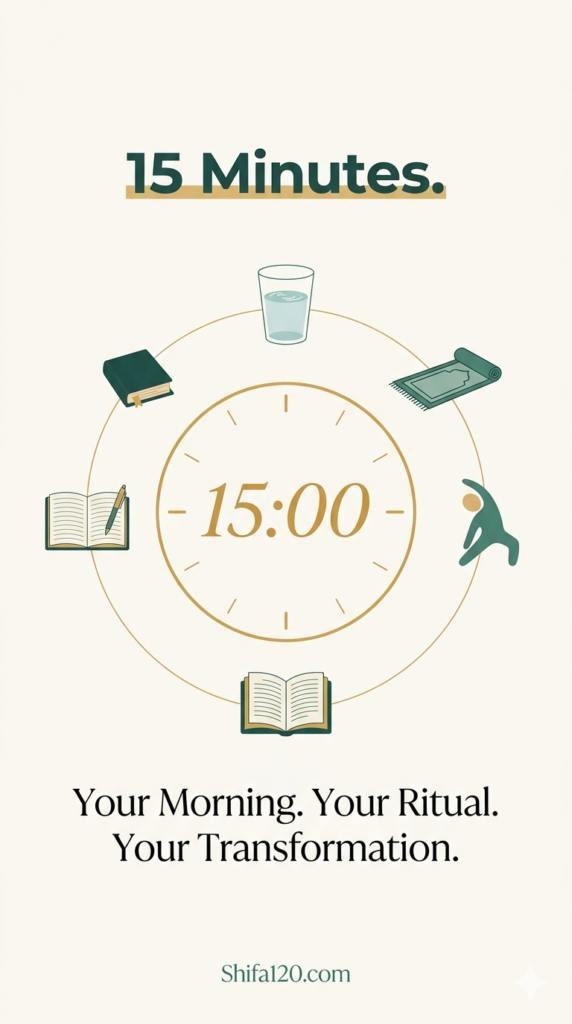
The 15-Minute
Morning Ritual That
Changes Everything
You do not need an hour. You do not need a gym membership, a cold shower, or a perfect morning. You need 15 deliberate minutes — and the right things to fill them with. This is the exact ritual.
In This Article
- Why 15 Minutes Is Enough — and Sometimes More Than an Hour
- The Science Behind the Morning Window
- The Complete 15-Minute Ritual — Minute by Minute
- Why Each Minute Works — The Mechanism
- Variations — For Different Situations
- When the Ritual Breaks — and How to Restart
- What 120 Days of This Ritual Produces
- Conclusion — 15 Minutes That Belong to You
There is a version of the morning routine story that has been told too many times. Wake at 4 AM. Cold shower. One hour of exercise. Journal for thirty minutes. Read for thirty minutes. Meditate. All before 7 AM. It sounds transformative in a book or on a podcast. In real life — with a job, a family, exhaustion, and the honest chaos of being human — it lasts about eleven days before collapsing completely.
This article is about something different. It is about what actually works — not what sounds impressive, not what the most disciplined version of you might sustain for two weeks, but what the real, tired, busy, imperfect version of you can actually do every single morning for 120 days without stopping.
The answer is 15 minutes. Not as a compromise. Not as the minimum before you eventually build up to the real routine. Fifteen minutes as a complete, sufficient, genuinely transformative morning practice — one that works through neuroscience, through spiritual alignment, and through the compound effect of consistent daily action over time.
Done every morning for 120 days, this ritual will change your energy, your focus, your emotional baseline, and your relationship with the most important hours of your day.
Why 15 Minutes Is Enough — and Sometimes More Than an Hour
The belief that a morning routine must be long to be effective is one of the most persistent and damaging myths in the wellness space. It has caused more people to abandon their morning practices than almost any other factor — because when life makes a sixty-minute routine impossible, most people treat it as all or nothing. No sixty minutes available means no routine at all.
The truth is more nuanced and more practical. The value of a morning routine does not come primarily from its duration. It comes from its consistency, its intentionality, and its physiological impact in the specific biological window of the early morning. A fifteen-minute practice that happens every single morning produces a fundamentally different cumulative effect from a sixty-minute practice that happens three or four mornings a week when conditions permit.
Consider the mathematics. Fifteen minutes every morning for 120 days is 1,800 minutes — 30 hours — of intentional, focused morning practice. That is more meaningful morning investment than most people make in several years of aspirational but inconsistent longer routines. The person who does fifteen minutes every day is not doing less than the person who attempts sixty minutes most days. Over 120 days, they are almost certainly doing significantly more.
“The most powerful morning practice is not the one that looks most impressive. It is the one that happens every single morning without exception — however long or short, however perfect or imperfect.”
There is also a neurological reason why fifteen minutes in the specific window of the early morning is disproportionately powerful. The first fifteen to twenty minutes after waking — before the phone is checked, before conversation begins, before any external input arrives — is a period of unique neurological receptivity. The brain is transitioning from sleep to wakefulness, the default mode network is still partially active, and the prefrontal cortex is beginning to engage. What you feed this window — what sensory input, what thoughts, what physical experiences you introduce in these first minutes — has an outsized influence on the neurological state you carry into the rest of the day.
The Science Behind the Morning Window
Three specific biological processes make the early morning window uniquely powerful for a short, intentional ritual — and understanding them explains why the same fifteen minutes at 5 AM produces different results from fifteen minutes at 10 AM.
The Cortisol Awakening Response
Within thirty to forty-five minutes of waking, your body produces a natural surge of cortisol — the Cortisol Awakening Response (CAR). This surge is your body’s built-in alertness and energy mechanism. It primes the prefrontal cortex for decision-making, sharpens attention, and mobilises energy for the morning. The CAR peaks and then gradually declines through the morning. The fifteen-minute ritual is designed to work with this peak — not against it. Activities that engage attention, produce physical activation, and orient the mind toward intention align perfectly with the CAR window and amplify its effects.
The Neuroplasticity Window
Research in neuroplasticity has identified the early morning — specifically the period immediately after waking — as a time of elevated neural plasticity. The brain in this state is more receptive to new patterns, more responsive to deliberate practice, and more capable of encoding habitual behaviours. This is why habits practised consistently in the morning establish faster and more durably than habits practised at other times of day. The fifteen-minute ritual takes advantage of this neuroplasticity window — each morning’s practice is slightly more deeply encoded than the same practice performed later in the day.
The Pre-Input Window
Before any external input — notifications, news, other people’s demands and realities — arrives and claims the brain’s processing resources, there is a brief window where the mind is oriented inward. Thoughts are self-generated rather than reactive. Attention is available rather than captured. This window closes the moment the phone is checked or a conversation begins. The fifteen-minute ritual is designed to occupy this pre-input window entirely — filling it with intentional practice before it can be claimed by the external world.
The Complete 15-Minute Ritual — Minute by Minute
Here is the exact ritual. Every minute is accounted for. Every activity has a specific neurological, physiological, or spiritual purpose. Nothing is included because it sounds good. Everything is included because it works.
Rise Immediately — Feet on Floor — One Glass of Water
The alarm sounds. You do not negotiate. You do not snooze. You sit up, swing your feet onto the floor, and stand. This is not a small thing. The act of getting up immediately — before the mind can generate reasons to stay — is the most important moment of the entire ritual. Every subsequent minute depends on this one. Standing upright triggers the postural reflexes that begin the biological waking process. Then: one glass of water. Not coffee. Not your phone. Water — before anything else enters the body or the mind. Ninety seconds. Done.
Wudu and Opening Prayer or Stillness
The cold water of wudu is one of the most powerful natural alertness triggers available — more effective, more immediate, and with no dependency or tolerance development compared to caffeine. The act of wudu is also a deliberate, structured ritual that orients the mind toward cleanliness, intention, and presence before anything else. For those who observe Fajr, these minutes encompass wudu and the beginning of prayer. For those beginning a different practice, this is two to three minutes of conscious stillness — standing in quiet, breathing deliberately, before the world makes its first claim on your attention. This is the spiritual anchor of the ritual — the moment that orients everything else toward meaning rather than urgency.
Four Minutes of Movement — No Equipment Required
Four minutes. That is all. Not a workout. Not a gym session. Four minutes of deliberate physical movement that takes the body from its sleep state to its active state — warming the joints, activating the postural muscles, elevating the heart rate slightly, and triggering the dopamine and serotonin release that makes the rest of the morning sharper and more energised. The specific movements matter less than the consistency. A simple sequence: thirty seconds of gentle neck rolls and shoulder circles; sixty seconds of standing hip circles and torso rotations; sixty seconds of bodyweight squats at a comfortable pace; sixty seconds of slow forward folds and calf stretches; thirty seconds of deep breathing with arms raised overhead. No mat required. No shoes required. Can be done in any room in any clothing.
Three Minutes of Gratitude and Intention
Sit. Take a breath. Write — by hand, in a small notebook — three things you are genuinely grateful for this morning. Not generic statements. Specific ones. “I am grateful that my children are healthy.” “I am grateful for the project that is moving forward.” “I am grateful for the quiet of this morning before anyone else is awake.” Then write — in one sentence — the single most important thing you intend to accomplish today. Not a to-do list. One thing. The most important one. This three-minute practice does something to the brain that is difficult to describe and well-documented in research: it shifts the day’s neurological baseline from reactive to intentional. The day begins with what you are grateful for and what you have decided matters most — not with whatever arrives first in your inbox.
Three Minutes of Quran or Meaningful Reading
The final three minutes belong to recitation or reading — the practice that feeds the mind and spirit rather than the body or the schedule. For the practising Muslim, this is three minutes of Quran recitation — slowly, with understanding, without rushing. Even three verses read with presence and attention produces a quality of inner stillness that is qualitatively different from the scattered, reactive mental state that most mornings begin with. For those beginning a different practice, these three minutes are used for reading from a book that nourishes — not news, not social media, not emails — but words that expand rather than agitate. The final three minutes of the ritual are its culmination: the mind, now awake, activated, grateful, and intentional, is fed with something worthy of the state it has been prepared to receive.
The Complete Ritual — Summary
- Minute 1: Rise immediately — feet on floor — one glass of water
- Minutes 2–5: Wudu and Fajr prayer opening — or conscious stillness
- Minutes 6–9: Four minutes of gentle movement — any room, no equipment
- Minutes 10–12: Three things you are grateful for + one daily intention — written by hand
- Minutes 13–15: Three minutes of Quran recitation or meaningful reading
Total: 15 minutes. No equipment. No gym. No perfect conditions required. Available every morning of your life.
Why Each Minute Works — The Mechanism
The Water
After six to eight hours without fluid intake, the body is mildly dehydrated. Even mild dehydration — as little as 1 to 2% of body weight — measurably impairs cognitive function, reaction time, and mood. Drinking one glass of water immediately on waking begins rehydration before any other physiological process. It also triggers the gastrocolic reflex — the body’s natural digestive activation — which begins to prepare the system for the day. In two minutes, without cost, without effort, and without any equipment, hydration begins the physical recovery from sleep.
A 2011 Journal of Nutrition study found that even mild dehydration equivalent to a 1.36% body weight loss impaired mood, increased the perception of task difficulty, and reduced concentration in both men and women. Morning hydration is not optional — it is the first physiological repair of the day.
The Wudu and Prayer
The cold water of wudu produces immediate cortical arousal — the brain’s alertness network activates in response to the cold stimulus. This is not merely anecdotal. Cold water contact with the face and extremities triggers the trigeminal nerve and the diving reflex — both of which produce rapid alertness responses in the central nervous system. The structured, deliberate nature of the wudu ritual also activates the prefrontal cortex’s executive function networks — the same networks responsible for planning, decision-making, and emotional regulation. Beginning the day by engaging these networks in a structured, meaningful act primes them for everything that follows.
The Movement
Four minutes of gentle movement produces measurable physiological effects that persist for hours. Joint synovial fluid — which lubricates and protects the joint surfaces — is redistributed through movement after the relative stillness of sleep. Core temperature rises slightly, which enhances alertness and cognitive performance. Most importantly, even four minutes of moderate movement produces a measurable increase in brain-derived neurotrophic factor (BDNF) — the protein responsible for the growth and maintenance of neurons. BDNF has been called “Miracle-Gro for the brain” — it directly supports learning, memory, and mood regulation. Four minutes of movement every morning for 120 days is a small but consistent investment in neurological health.
The Gratitude and Intention
Gratitude practice has been studied extensively in positive psychology. The mechanism is specific: writing down specific things you are grateful for activates the brain’s reward circuitry through the deliberate recall of positive experiences. This produces a small but genuine release of dopamine and serotonin — the neurotransmitters most directly associated with motivation and positive mood. Over time, consistent gratitude practice restructures the brain’s default interpretive framework — the lens through which events are automatically evaluated — shifting it gradually toward the positive. This shift does not make difficult things easier. It makes the same difficult things less depleting — which over 120 days produces a measurable improvement in psychological resilience.
The single daily intention — one sentence about the most important thing today — activates what psychologists call implementation intention. Research by Peter Gollwitzer at New York University demonstrates that people who form a specific intention (“I will do X today”) are significantly more likely to follow through than those who have a general goal (“I want to be more productive”). The morning intention practice is a one-sentence implementation intention that takes thirty seconds and consistently increases the probability of the most important work getting done.
The Quran or Meaningful Reading
The final three minutes represent the deepest investment of the ritual. The brain — now awake, hydrated, physically activated, and emotionally oriented — is in its most receptive state of the day. What enters this state leaves a mark. Quran recitation, specifically, produces a quality of focused attention — one thought, one word, one meaning at a time — that is in direct opposition to the scattered, multi-channel attention that modern life encourages at every other moment. This three-minute practice is also a deliberate choice: to feed the mind with the sacred before feeding it with the urgent. That choice, made consciously every morning for 120 days, gradually changes the hierarchy of what feels important and what feels worth attention.
Variations — For Different Situations
The base ritual above is designed for a normal morning with fifteen uninterrupted minutes. Real life presents different conditions. Here are the adaptations for four common situations:
The Emergency Version
- Rise immediately — no snooze
- One glass of water — 90 seconds
- Wudu — 60 seconds
- One minute of stillness — eyes closed, three deep breaths, one intention spoken aloud
- Open the Quran — read one ayah with presence
The Extended Version
- Rise immediately — water
- Wudu and full Fajr prayer — 15 minutes
- 10 minutes of movement — walk outside if possible
- 5 minutes — gratitude, intention, Quran recitation
- Sit in dhikr until sunrise
The Travel Version
- Rise at local equivalent of home wake time
- Water from bedside bottle prepared night before
- Wudu in hotel bathroom
- Prayer facing qibla — direction found on phone before sleep
- Two minutes of room stretching — no mat needed
- Gratitude and intention — written in phone notes if no journal
The Minimum Version
- Rise at your fixed time — even if you return to rest after
- Water — always
- Wudu if physically able
- Prayer seated if standing is difficult
- One gratitude thought — spoken, not written
- Skip movement entirely — rest is the medicine
The principle across all variations is identical: something is always better than nothing. The version of the ritual that happens on a difficult morning — even the two-minute version, even the seated version — is worth infinitely more than the perfect ritual that does not happen because conditions were not right. The chain of daily practice is more important than the quality of any individual morning.
When the Ritual Breaks — and How to Restart
The ritual will break. Not might break — will. There will be a morning when the alarm goes off and you genuinely cannot get up. An illness that leaves you unable to stand. A family emergency that consumes the morning entirely. A night so difficult that five minutes is genuinely all that is available and even that feels impossible.
When the ritual breaks, three things are true simultaneously:
- One missed morning has almost no effect on the long-term habit. The neuroscience of habit formation is clear on this: a single missed day does not meaningfully disrupt the habit loop that has been building. What disrupts it is the belief that missing one day means failure — which leads to missing two, then three, then abandoning the practice entirely.
- The restart is always available — immediately. The ritual does not need to be resumed on a Monday, or at the start of a new month, or after some preparatory period. It resumes tomorrow morning. The next morning after a missed morning is not a second chance — it is simply the next morning.
- The minimum version counts fully. On the morning after a difficult night, five minutes of water, wudu, and one line of Quran is not a failed attempt at the full ritual. It is the full ritual, adapted appropriately to the conditions. It keeps the chain. That is all that matters.
The One Rule for Restarting
Never miss twice in a row. This is the only rule you need for long-term ritual maintenance. Miss a morning — for whatever reason, without guilt — and make the next morning non-negotiable. Not perfect. Not complete. Just present. That single rule, consistently applied, will carry a morning ritual through every disruption that life produces over 120 days and beyond.
What 120 Days of This Ritual Produces
The changes that 120 days of consistent morning ritual produce are not dramatic events. They are gradual, cumulative, and often noticed only in retrospect — when you look back at the person who began on Day 1 and compare them to the person standing on Day 120.
In the First 30 Days
The ritual is still effortful. Waking requires conscious decision. The water feels mechanical. The movement feels like a chore. The gratitude writing feels forced. This is normal and expected — the habit loop is not yet encoded, and everything is still running on willpower and intention. The most important thing in the first thirty days is simply to show up. The quality of each individual morning matters much less than the accumulation of consecutive mornings.
In Days 31 to 60
Something shifts around this point for most people. The ritual begins to feel less like a decision and more like a sequence. The body begins to anticipate the water before the first sip. The movement sequence begins to feel natural rather than forced. The gratitude writing becomes slightly easier — specific things start coming to mind more readily. The Quran recitation begins to feel like nourishment rather than obligation. This is the beginning of automaticity — the early evidence that the basal ganglia is beginning to own the sequence.
In Days 61 to 90
The ritual is now largely automatic. Missing it feels wrong. On the mornings when it is not possible to complete it fully, there is a genuine sense of something missing — an incompleteness that motivates the minimum version rather than abandonment. The gratitude practice has begun to shift the default emotional tone of the mornings — there is a slightly but measurably more positive baseline compared to before the practice began. The movement habit means the body wakes more quickly and with less stiffness.
In Days 91 to 120
The ritual is identity. It is no longer something you do — it is part of who you are. You are a person who begins every day with intention. You are a person who drinks water before coffee. You are a person who moves before the world demands movement. You are a person who writes gratitude before checking notifications. You are a person who reads Quran before opening email. These are not behaviours you perform. They are characteristics of who you are. That identity — built through 120 mornings of fifteen deliberate minutes — is one of the most valuable things a person can own.
15 Minutes That Belong to You
Before the world makes its first demand of the day, before the phone lights up with someone else’s urgency, before work begins and family begins and obligation begins — there are fifteen minutes that belong entirely to you. They are available every morning. They cost nothing. They require no equipment, no gym membership, no perfect conditions, and no extraordinary discipline.
They require only this: that you rise when the alarm sounds, that you drink the water, that you perform the wudu, that you move the body, that you write the gratitude and the intention, that you open the Quran — and that you do these things in sequence, every morning, without exception, for 120 days.
On Day 1, these fifteen minutes will feel like discipline. On Day 30, they will feel like practice. On Day 60, they will feel like habit. On Day 120, they will feel like home. And the day that begins with fifteen intentional minutes — no matter what follows — is a different kind of day from the one that begins reactively, rushed, and already behind.
Start tomorrow. Not with the perfect ritual. Not with the extended version. With fifteen minutes and the first step: rise immediately, put your feet on the floor, drink a glass of water, and let the morning begin on your terms.
That is everything.
Begin Your 120-Day Morning Transformation
Download the free 7-Day Starter Guide at Shifa120.com and take your first structured step toward the morning — and the life — you were created for.
Start at Shifa120.com →