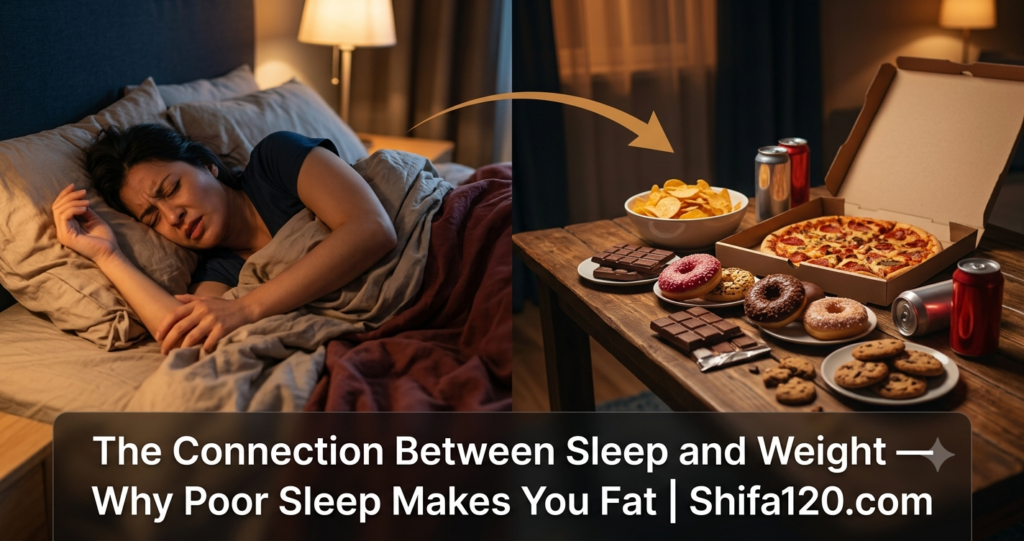
If you are eating carefully and exercising regularly but still struggling to lose weight — your sleep may be the missing variable that nobody told you about.
The connection between sleep and body weight is not a theory. It is documented, replicated biology. Poor sleep does not just make you tired — it directly alters the hormones that control your hunger, your metabolism, and your body’s decision about whether to store fat or burn it.
What Poor Sleep Does to Your Hunger Hormones
Your appetite is controlled by two hormones working in balance:
Ghrelin — the hunger hormone. It rises before meals and signals your brain that you need to eat. The higher your ghrelin, the stronger your appetite.
Leptin — the satiety hormone. It signals your brain that you have eaten enough and should stop. The higher your leptin, the sooner you feel full.
When you sleep well — these two hormones stay in balance. When you are sleep deprived — even mildly, even by just one hour per night — this balance breaks down completely.
Ghrelin rises. Leptin falls.
The result is a biological drive to eat more — not because you need more calories, but because your hormones are signalling hunger that does not reflect your actual energy needs. You are not weak. You are not lacking willpower. Your hormones are working against you because of insufficient sleep.
Research published in the journal Sleep found that even one night of poor sleep increased ghrelin levels significantly and reduced leptin — leading subjects to consume an average of 300 to 500 additional calories the following day without any awareness that they were eating more than usual.
The Cortisol Problem
Sleep deprivation elevates cortisol — your primary stress hormone. Chronically elevated cortisol has a specific metabolic effect that most people are not aware of.
It signals your body to store fat — particularly visceral fat around the abdomen.
Visceral fat is not just a cosmetic problem. It surrounds your internal organs, increases inflammation, raises insulin resistance, and is directly associated with increased risk of type 2 diabetes, heart disease, and metabolic syndrome.
Poor sleep raises cortisol. Elevated cortisol drives fat storage. The fat accumulates specifically in the most dangerous location — the abdomen. This is not a coincidence. It is a direct hormonal cascade triggered by insufficient sleep.
Insulin Resistance and Blood Sugar
Sleep deprivation reduces insulin sensitivity. Your cells become less responsive to insulin — the hormone that moves glucose from your bloodstream into your cells for energy use.
When cells do not respond to insulin efficiently, your pancreas produces more insulin to compensate. Excess insulin in the bloodstream promotes fat storage and makes fat burning significantly harder.
Studies have shown that just one week of sleeping six hours per night instead of eight hours produces measurable reductions in insulin sensitivity — equivalent to the effect seen in early-stage type 2 diabetes.
The food you eat is being stored rather than burned — not because of what you ate, but because of how little you slept.
The Food Choice Effect
Poor sleep does not just make you hungrier. It changes what you want to eat.
Sleep deprivation activates the reward centres of the brain while simultaneously reducing activity in the prefrontal cortex — the area responsible for rational decision making and impulse control. This neurological combination makes high-calorie, high-sugar, and high-fat foods significantly more appealing — and makes it much harder to choose the healthier option even when you intend to.
This is why late-night snacking is so strongly associated with poor sleep. The brain, operating in a state of sleep deprivation, seeks the fastest available energy source — which is always the most calorie-dense food available.
The Muscle and Metabolism Impact
Deep sleep is when growth hormone is released — the primary hormone responsible for muscle repair and maintenance. When deep sleep is reduced, growth hormone output falls.
Less growth hormone means slower muscle repair, reduced muscle maintenance over time, and a lower resting metabolic rate. Muscle tissue burns more calories at rest than fat tissue — so losing muscle mass directly reduces the number of calories your body burns every day, making weight management progressively harder.
Poor sleep simultaneously makes you eat more and burn less. The combination is powerful and compounding.
How Much Sleep You Actually Need
The optimal sleep duration for most adults is 7 to 9 hours per night. Within this range — hunger hormones are balanced, cortisol follows its natural rhythm, insulin sensitivity is maintained, and growth hormone is released in adequate amounts.
Below 6 hours per night — the hormonal disruption described above becomes clinically measurable. Below 5 hours per night — the metabolic consequences are significant and accumulate rapidly.
Sleep debt — the accumulated deficit from chronic short sleeping — cannot be fully repaid with one long sleep at the weekend. The hormonal consequences of chronic sleep deprivation require consistent nightly sleep to reverse.
The Shifa120 Approach — Sleep as a Weight Management Tool
At Shifa120 we treat sleep as one of the five foundational pillars of health transformation — alongside fasting windows, dietary choices, post-meal movement, and daily discipline.
If you are working to manage your weight — and you are not prioritising 7 to 8 hours of quality sleep every night — you are working against your own biology. The calorie restriction and exercise you are doing are fighting a hormonal environment that poor sleep has set against you.
Fix the sleep first. The weight management becomes significantly easier when your hunger hormones, cortisol, and insulin are working with you rather than against you.
Three actions to start tonight:
- Set a consistent sleep time — the same every night including weekends
- Stop eating 2 hours before your sleep time — removing late-night eating removes its compounding damage
- Keep your bedroom at 18°C to 20°C — your body needs to cool to enter deep, restorative sleep
Small. Consistent. Over 120 days — transformative.
This post is part of the Shifa120 wellness transformation programme. Learn more at shifa120.com.