By Mohammad Iftakhar Ahmad Author — The 120-Day Miracle | Founder, Shifa120.com
Introduction
Most people who want to improve their health make the same mistake.
They try to change everything at once.
They overhaul their entire diet on Monday morning. They eliminate sugar, flour, processed food, caffeine, and everything they enjoy — all in the same week. They start exercising every day, drinking eight glasses of water, sleeping earlier, and meditating — simultaneously.
By Friday they are exhausted, hungry, and resentful. By the following Monday they are back to exactly where they started — with the added weight of another failed attempt on their conscience.
This cycle is not a character flaw. It is a design flaw.
The human brain and body do not change through overwhelming force. They change through consistent, sustainable, well-targeted action. One powerful change, made consistently, produces more lasting transformation than ten simultaneous changes made unsustainably.
In this post I want to share the single most impactful meal change I made during my 120-day transformation — the one change that, if you make it and keep it for 30 days, will produce more measurable improvement in your weight, your blood sugar, your energy, and your overall health than almost anything else you could do.
It is not complicated. It is not expensive. It does not require special food, a nutritionist, or a meal plan.
But it requires understanding why it works — so that you are making the change with knowledge and conviction, not just following instructions.
First — Why the First Meal of the Day Is the Most Important Target
Before I tell you what the change is, I want you to understand why the first meal of the day is the highest-leverage target for health transformation.
Your body operates on a biological clock — the circadian rhythm. This internal clock regulates virtually every system in your body — your hormones, your metabolism, your immune function, your digestion, and your sleep cycles — according to a 24-hour schedule aligned with the cycle of light and darkness.
One of the most important features of the circadian rhythm is that your body’s metabolic machinery — the systems that process food, manage blood sugar, and regulate hunger — are most active and most efficient in the morning hours and progressively less efficient as the day goes on.
This means that your body processes exactly the same meal very differently depending on what time you eat it.
A meal eaten at 7 AM produces a significantly smaller blood sugar spike, requires less insulin, and is converted to energy more efficiently than the exact same meal eaten at 7 PM. Studies published in the journal Obesity and in Cell Metabolism have confirmed this circadian variation in metabolic response — showing that insulin sensitivity is highest in the morning and decreases significantly through the afternoon and evening.
The practical implication of this science is profound.
What you eat for your first meal of the day — and when you eat it — has a disproportionate influence on your blood sugar, your hunger, your energy, your cravings, and your fat storage for the entire rest of the day.
Get the first meal right — and the rest of the day becomes easier. Get the first meal wrong — and you spend the rest of the day fighting cravings, energy crashes, and hunger that no amount of willpower can overcome.
This is why the first meal is the highest-leverage target. And this is why changing it produces the most impact.
The Most Common First Meal — and Why It Is Destroying Your Health
Before I describe the change, let me describe what most people eat for their first meal — and why it is working against them.
The most common breakfast in the modern world consists of some combination of the following: white bread or toast, processed cereal, sweetened yogurt, fruit juice, pastries, biscuits, white rice, or sugary coffee drinks.
These foods have one thing in common. They are dominated by rapidly digesting carbohydrates — sugars and refined starches that convert to glucose in the bloodstream within 15 to 30 minutes of eating.
When you eat these foods in the morning, your blood glucose rises sharply and rapidly. Your pancreas responds by releasing a large amount of insulin to clear the glucose from the bloodstream. Your blood sugar then drops — often below fasting levels — producing the familiar mid-morning energy crash, brain fog, irritability, and intense hunger that drives you toward the biscuit tin or the vending machine before 10 AM.
This blood sugar spike and crash cycle — repeated at every meal — is the fundamental driver of insulin resistance, type 2 diabetes, chronic fatigue, obesity, and metabolic disease in the modern world.
It is not caused by eating too much. It is caused by eating the wrong things at the wrong time in the wrong combination.
And it begins at breakfast.
The One Meal Change — Replace Your Current Breakfast With a Protein and Healthy Fat Dominant Meal
The single most impactful change you can make is this.
Replace your current breakfast — whatever it currently is — with a meal that is dominated by protein and healthy fat, with slow-digesting complex carbohydrates as the secondary component.
This change alone — made consistently for 30 days — will produce measurable improvements in your weight, your blood sugar stability, your energy levels, your hunger patterns, and your overall health.
Let me explain exactly what this means and why it works so powerfully.
What Protein and Healthy Fat Do to Your Blood Sugar and Hormones
Protein and fat digest slowly. Unlike refined carbohydrates that convert to glucose within 15 to 30 minutes, protein takes 3 to 4 hours to digest and fat takes even longer. This slow digestion produces a gradual, steady release of glucose into the bloodstream — not the sharp spike produced by refined carbohydrates.
The result is that your blood sugar remains stable for 3 to 5 hours after a protein and fat dominant breakfast. No spike. No crash. No mid-morning hunger. No cravings.
There is more.
Protein is the most satiating macronutrient. Research consistently shows that meals high in protein produce a significantly greater feeling of fullness than meals of equivalent calories from carbohydrates or fat. A protein-dominant breakfast reduces your total calorie intake for the entire day — not through willpower, but through hormonal satiety. You simply do not feel hungry.
Protein stimulates the release of peptide YY and GLP-1 — two gut hormones that signal fullness to the brain. It suppresses ghrelin — the hunger hormone — more effectively than any other macronutrient. It also requires more energy to digest than carbohydrates or fat — a phenomenon called the thermic effect of food — which means your metabolism is slightly elevated for hours after a high-protein meal.
Healthy fat — from eggs, avocado, nuts, olive oil, and oily fish — provides sustained energy that does not spike blood sugar. Fat also slows the absorption of any carbohydrates eaten alongside it — further blunting the blood sugar response.
Together protein and healthy fat create a metabolic environment in the morning that supports stable blood sugar, sustained energy, reduced hunger, and efficient fat burning — for the entire rest of the day.
What to Actually Eat — Practical Examples
The meal change I am recommending is not complicated and it is not expensive. Here are practical examples of what a protein and healthy fat dominant breakfast looks like.
Option 1 — Eggs with Vegetables
Two or three eggs — boiled, scrambled, or fried in a small amount of olive oil — with a generous portion of vegetables such as spinach, tomatoes, mushrooms, or bell peppers. Add half an avocado if available.
This meal provides 20 to 25 grams of protein, plenty of healthy fat, fibre from the vegetables, and almost no rapidly digesting carbohydrate. Blood sugar response is minimal. Satiety lasts 4 to 5 hours.
Option 2 — Full-Fat Plain Yogurt With Nuts and Berries
A bowl of full-fat plain yogurt — not flavoured, not sweetened — with a tablespoon of mixed nuts and a small handful of berries.
This meal provides protein from the yogurt, healthy fat from the nuts, slow-digesting carbohydrates from the berries, and probiotic benefit from the yogurt cultures. The blood sugar response is gentle and sustained.
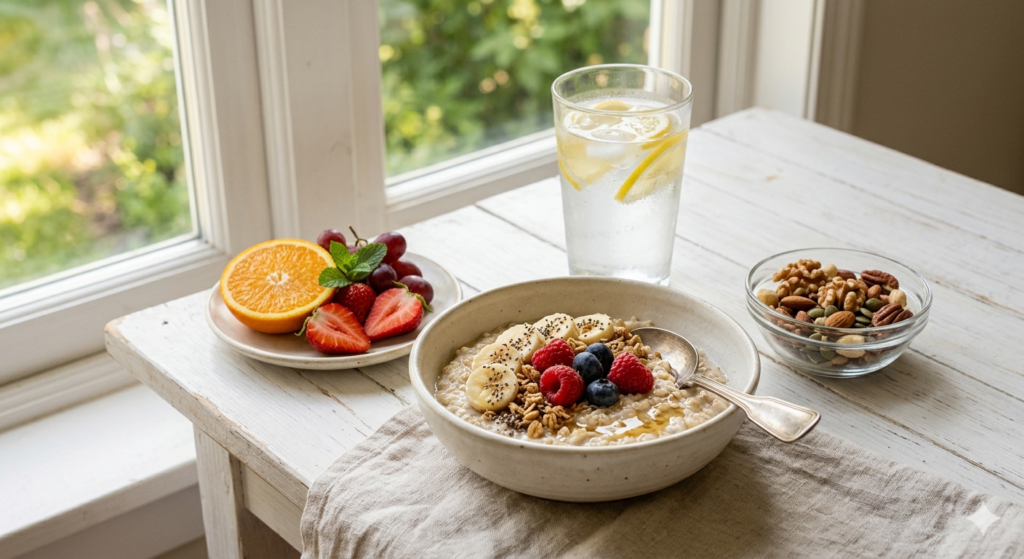
Option 3 — Oats With Nuts, Seeds, and No Added Sugar
Steel-cut or rolled oats — not instant oats — cooked with water and topped with a tablespoon of nut butter, a tablespoon of mixed seeds, and a small amount of fresh fruit.
The combination of oat fibre, protein from the nut butter, and fat from the seeds dramatically slows glucose absorption compared to oats eaten alone. This is a significantly better option than commercial cereal or sweetened porridge.
Option 4 — Leftover Protein From the Previous Meal
In many cultures, particularly across Asia and the Middle East, savoury protein-based foods are entirely normal at the first meal of the day. Lentils, legumes, grilled meat, fish, or vegetable-based protein dishes are excellent breakfast options and are far superior metabolically to sweet, refined carbohydrate-based breakfasts.
Do not let the cultural association of breakfast with sweet foods prevent you from eating what your body actually needs in the morning.
Option 5 — A High-Protein Smoothie
A smoothie made with full-fat plain yogurt or a small amount of protein-rich ingredients such as hemp seeds, chia seeds, or nut butter — blended with leafy greens, a small amount of fruit, and water or unsweetened plant milk — can provide a quick, convenient protein and fat dominant breakfast when time is limited.
Avoid smoothies that are predominantly fruit juice or sweetened milk. These are essentially liquid sugar and produce exactly the blood sugar spike you are trying to avoid.
What to Remove From Your Breakfast
The protein and fat dominant breakfast works only if you also remove the elements that undermine it.
Remove sweetened drinks. Fruit juice, sweetened coffee, flavoured milk drinks, and sweetened tea taken with breakfast add a significant glucose load that spikes blood sugar and triggers the insulin response you are trying to avoid. Replace them with water, black coffee, black tea, or herbal tea without sugar.
Remove white bread, white toast, and processed cereals. These are the primary drivers of the morning blood sugar spike. Even small amounts eaten alongside protein and fat will partially undermine the blood sugar stability that the protein and fat provide.
Remove pastries, biscuits, and sweetened yogurts. These are essentially dessert foods eaten at breakfast time. They provide almost no nutritional value, spike blood sugar sharply, and contribute directly to insulin resistance and weight gain.
Remove fruit juice entirely. This is one of the most important removals. Fruit juice — even freshly squeezed fruit juice — is concentrated sugar with virtually no fibre. A glass of orange juice contains approximately the same amount of sugar as a can of soft drink. Eat the whole fruit instead — the fibre in the whole fruit dramatically slows glucose absorption.
What Will Happen in the First 30 Days
If you make this single change — replacing your current breakfast with a protein and healthy fat dominant meal — and maintain it consistently for 30 days, here is what you can expect to experience.
In the first week you will likely notice that your mid-morning hunger — if you normally experience it — is significantly reduced or eliminated. You may feel more mentally clear and energetic in the morning hours. If you currently drink coffee or tea primarily for energy by mid-morning, you may find you need it less.
In the second week your body begins adapting to a more stable blood sugar pattern. Cravings for sweet foods in the mid-morning and early afternoon begin to reduce. Your appetite at lunchtime is more moderate — you eat what you need and feel satisfied rather than eating urgently from prolonged hunger.
In the third week the hormonal adaptation deepens. Ghrelin patterns are beginning to recalibrate around your new eating pattern. If you are overweight, you may begin to see measurable changes on the scale — not from calorie restriction, but from reduced total daily food intake driven by improved satiety hormones.
In the fourth week the change is becoming a habit. Your body expects and prepares for the protein and fat dominant breakfast. The digestive, hormonal, and metabolic benefits are functioning consistently. By the end of 30 days, most people who make this change report sustained morning energy, significantly reduced mid-morning and afternoon cravings, improved mood and mental clarity, more moderate appetite throughout the day, and measurable improvement in blood sugar stability.
For those managing type 2 diabetes or prediabetes, the improvement in fasting blood sugar and post-breakfast blood sugar can be significant and measurable within 30 days. I experienced this directly during my own transformation — improving my breakfast was one of the first changes that began to shift my blood sugar markers in a positive direction.
The Deeper Principle — Signal Your Body From the First Meal
There is a deeper principle behind this change that goes beyond blood sugar and hormones.
The first meal of the day is a signal.
It tells your body what kind of day this will be. It sets the metabolic tone. It calibrates your hunger hormones. It establishes your energy trajectory.
A high-sugar, refined carbohydrate breakfast signals your body that glucose is abundant and immediately available — triggering insulin, promoting fat storage, and setting up the spike-and-crash pattern that dominates the rest of the day.
A protein and healthy fat dominant breakfast signals your body that it has real, sustained nourishment — triggering satiety hormones, stabilising blood sugar, and establishing a steady energy trajectory that supports clear thinking, controlled appetite, and efficient fat burning throughout the day.
You are not just choosing what to eat. You are choosing what kind of metabolic environment your body will operate in for the next 12 hours.
This is why one meal change — the right meal change — produces more impact than ten other changes combined. Because it changes the foundation that everything else is built on.
My Personal Experience
During my 120-day transformation I made many changes. But the one that produced the most immediate and measurable impact in the first 30 days was changing my breakfast.
Before the transformation my first meal was typical of what most people in my situation ate — sweet tea with sugar, white bread, and processed foods that spiked my blood sugar before 7 AM and left me hungry and craving again by 9 AM.
When I changed my breakfast to eggs with vegetables, or yogurt with nuts and a small amount of fruit, everything changed within two weeks.
My mid-morning hunger disappeared. My blood sugar readings before lunch were consistently lower than before. My mental clarity in the morning hours — which is when I do my most important thinking and planning — improved noticeably. My appetite at lunch was more moderate and controlled.
By the end of 30 days this one change had measurably contributed to the improvement in my blood sugar markers that my doctor later confirmed.
It did not require buying expensive food. It did not require a personal chef or a complicated meal plan. It required understanding why the change mattered — and making it consistently, every morning, without exception.
How to Make This Change Stick
One of the most important factors in making any health change last is reducing the friction between the decision and the action.
Prepare your breakfast the night before when possible. Boil eggs in advance. Portion nuts and seeds into small containers. Have yogurt ready in the refrigerator. The morning is when decision fatigue is lowest, but preparation friction can still derail good intentions.
Eat within one to two hours of waking. Do not skip breakfast entirely on the assumption that fasting longer is always better. For most people who are not following a structured intermittent fasting protocol, eating a protein and fat dominant breakfast within one to two hours of waking provides the metabolic signals that set up the best possible day.
Do not allow one bad day to become two. If you miss a day or make a poor breakfast choice, that is one meal. It does not undo 29 days of good choices. Get back on track immediately at the very next meal.
Tell someone you are making this change. Accountability multiplies consistency. Share this commitment with a family member, a friend, or in the comments section of this post. When someone else knows what you are doing, you are more likely to do it.
Track one measurement for 30 days. It does not need to be complex. Weigh yourself once per week. Check your fasting blood sugar every morning if you have a monitor. Note your mid-morning energy level. One simple measurement tracked consistently gives you evidence that the change is working — and evidence is the strongest motivator there is.
Conclusion — One Change. Thirty Days. Real Results.
You do not need to overhaul your entire life to start improving your health.
You need to find the highest-leverage change — the one change that, if made consistently, will produce the greatest improvement across the most important health markers simultaneously.
For most people that change is breakfast.
Replace what you are currently eating in the morning with a meal dominated by protein and healthy fat. Remove the sugar, the refined carbohydrates, and the sweetened drinks. Make this one change every single morning for 30 days.
In 30 days your blood sugar will be more stable. Your morning energy will be more sustained. Your cravings will be reduced. Your appetite will be more moderate. Your body will be functioning more efficiently.
And most importantly — you will have proven to yourself that you can make a change and keep it.
That proof is worth more than any diet plan. Because the discipline, consistency, and self-trust that you build in these 30 days is the foundation for every subsequent change you choose to make.
Start tomorrow morning.
Not next Monday. Not after the weekend. Tomorrow morning.
One meal. Thirty days. Real results.
Have you tried changing your breakfast before? What happened? Share your experience in the comments below — I read every reply personally.
Mohammad Iftakhar Ahmad Author — The 120-Day Miracle — Available on Amazon KDP Founder — Shifa120.com contact@shifa120.com www.shifa120.com