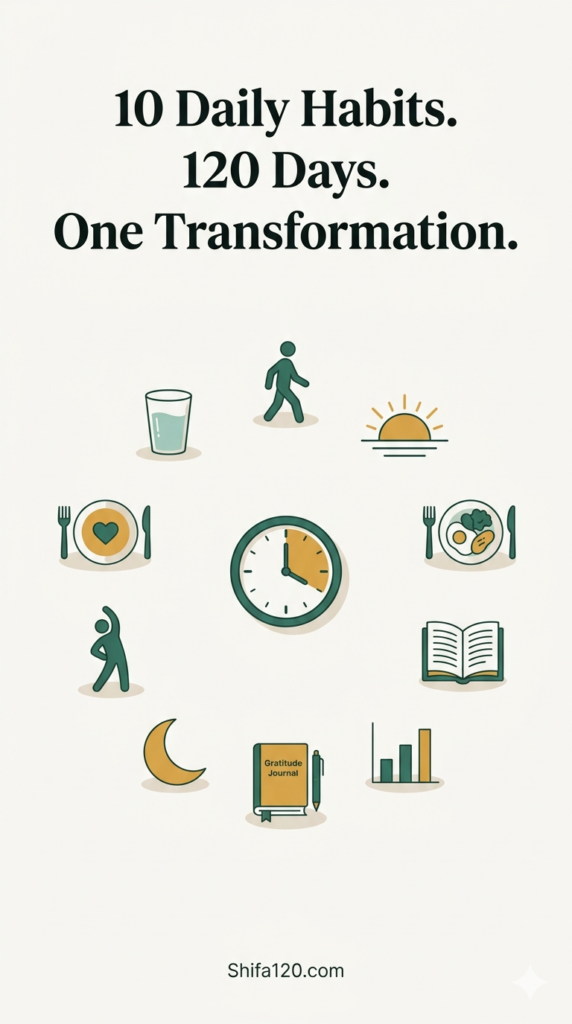
10 Small Daily Habits That Produce
Big Results in 120 Days
No extreme diets. No impossible gym routines. Just ten small, consistent actions — practised every single day — that compound into a transformation you will not believe is possible.
Most people who want to transform their health make the same mistake. They look for the big thing — the dramatic diet, the intense workout programme, the life-changing supplement. They go hard for two weeks, burn out, and return to exactly where they started. Sometimes they end up worse, because failure adds to the weight of self-doubt they were already carrying.
The truth — and it is a truth backed by both science and lived experience — is that transformation is not built from big moments. It is built from small ones, repeated daily. A habit that takes five minutes but is done every day for 120 days is worth infinitely more than an intense programme that lasts two weeks.
This is the foundation of the Shifa120 method. Not perfection. Not intensity. Consistency over 120 days. The ten habits below are small enough to start today and powerful enough, when stacked together, to change your health, your energy, your weight, your sleep, and your relationship with yourself.
“You do not rise to the level of your goals. You fall to the level of your systems. Build the system — one small habit at a time.”
Read each habit carefully. Do not try to implement all ten on day one. Start with the first three. Add the next three in week two. By week three, all ten are running — and by day 120, you will understand why small things done consistently are the most powerful force in human health.
Wake Up at the Same Time Every Day
Circadian Rhythm ResetYour body runs on a biological clock called the circadian rhythm. When you wake at different times each day — 6 AM on Monday, 9 AM on Friday, 7:30 AM on Saturday — you constantly disrupt this clock. The result is poor sleep quality, morning fatigue, low energy throughout the day, and disrupted hormone production including cortisol, melatonin, and insulin.
The fix is simple and costs nothing. Choose a wake time and hold it every day — including weekends. Within two to three weeks, your body will begin to wake naturally just before your alarm. Your morning cortisol peak — the hormone that gives you energy and mental clarity — will align with your wake time, and your days will begin with a genuine sense of energy rather than the desperate need for a second cup of coffee.
For those who practise Fajr prayer, this habit already exists. The discipline of rising before dawn is not just a spiritual practice — it is one of the most powerful biological resets a human being can perform. Fajr is the original circadian alignment tool.
Drink Two Glasses of Water Before Anything Else
Morning Hydration ProtocolAfter six to eight hours of sleep, your body is mildly dehydrated. Your blood is slightly thicker, your organs are waiting for fluid, and your brain — which is 75% water — is operating below its optimal capacity. The first thing most people do in this state is drink coffee. Caffeine, as a diuretic, makes the dehydration slightly worse before it makes you feel better.
Before coffee, before breakfast, before your phone — drink two full glasses of water. This takes ninety seconds. The effects are immediate and cumulative: better digestion, improved kidney function, clearer skin, sharper morning focus, and a natural reduction in appetite that helps with weight management over time.
Add a slice of lemon if available. The citric acid supports liver function and the small amount of vitamin C supports immune response. Over 120 days, this single habit will change your morning energy more than any supplement you could buy.
Move Your Body for 20 Minutes — Every Single Day
Non-Negotiable Daily MovementNot a gym session. Not a structured workout programme. Just twenty minutes of movement every day without exception. A walk. A short home workout. Stretching and bodyweight exercises. Swimming. Cycling. The specific activity matters far less than the consistency.
The science on daily moderate movement is unambiguous. Twenty minutes of walking per day reduces cardiovascular disease risk by up to 30%, improves insulin sensitivity, reduces cortisol levels, boosts serotonin and dopamine production, and improves sleep quality — all simultaneously. It is the single most evidence-backed intervention in preventive medicine, and it costs nothing.
The mistake people make is waiting until they “feel motivated” to exercise. Motivation follows action, not the other way around. Commit to the twenty minutes regardless of how you feel. On the days you feel least like moving, the movement will give you the most return. After sixty days of daily movement, the habit becomes part of your identity — you will feel genuinely uncomfortable on a day you do not move.
Eat Your Last Meal Before 8 PM
Time-Restricted EatingYour digestive system has its own circadian rhythm. In the evening, your body begins to shift from an active metabolic state to a repair and recovery state. When you eat late at night — heavy meals at 10 PM or 11 PM — you force your digestive system to work during the hours it is biologically scheduled to rest. The consequences accumulate over time: poor sleep, acid reflux, fat storage, sluggish morning energy, and increased inflammation.
Setting a simple rule — no food after 8 PM — is one of the most impactful interventions in metabolic health. It automatically creates a twelve to fourteen hour overnight fast between your last meal and your first meal the next day. This fasting window allows insulin levels to drop, triggers cellular repair processes, improves fat metabolism, and produces markedly better sleep quality because the body is not diverting energy to digestion during the night.
This is not extreme fasting. It is simply aligning your eating window with your biology. Start with 8 PM, and if it feels manageable after thirty days, move it to 7:30 PM. The earlier your last meal, the greater the metabolic benefit.
Replace One Processed Meal with a Real Food Meal Daily
Nutritional UpgradeDo not overhaul your entire diet on day one. That approach fails almost universally because it requires willpower to override deeply established eating habits simultaneously across every meal. Instead, make one single upgrade: replace one processed meal per day with a real, whole food meal.
Real food means food that has not been significantly altered from its natural state. Eggs, vegetables, fruits, legumes, whole grains, lean meat, fish, nuts. Not packaged, not fried, not loaded with preservatives and refined sugar. Just food as it exists in nature, cooked simply.
Over 120 days, this single daily upgrade reduces your daily intake of refined carbohydrates, added sugar, processed seed oils, and artificial additives significantly — without requiring you to calculate macros, count calories, or follow a restrictive eating plan. Your palate will also shift over this period. Foods that were previously appealing because of their sugar and salt content will gradually taste excessive and artificial. Real food will begin to taste better.
Spend 10 Minutes in Silence or Reflection Each Morning
Mental Clarity PracticeThe modern morning is a sensory assault. The phone is checked before the eyes are fully open. Notifications, news, social media, messages — all of it floods the mind before it has had a moment to settle into the day. The result is a baseline state of low-level anxiety and reactive thinking that persists throughout the day.
Ten minutes of silence each morning — before screens, before conversation, before the day begins — is a neurological reset. Whether you use this time for prayer, meditation, deep breathing, journaling, or simply sitting in quiet reflection, the effect on the nervous system is measurable. Cortisol levels are lower, decision-making quality improves, emotional reactivity decreases, and the quality of focus throughout the day is meaningfully better.
For those with a spiritual practice, this habit merges naturally with morning worship. The stillness of Fajr time — before the world wakes — is an extraordinary gift that most people do not realise they are sitting inside. Use it deliberately. Ten minutes of intentional silence in the early morning is worth more than an hour of scattered thinking later in the day.
Halfway There — The Compound Effect Is Building
By the time you have these first six habits running consistently, something important is happening that you may not yet be able to see clearly. Each habit is not just producing its own individual result — the habits are interacting with each other and amplifying each other’s effects.
- Waking consistently improves sleep quality, which reduces food cravings the next day
- Morning hydration improves energy, which makes the 20-minute walk feel easier
- Eating before 8 PM improves sleep, which makes waking consistently easier
- Morning silence reduces anxiety, which reduces stress eating later in the day
This is the compound effect in action. Small habits, stacked and consistent, do not produce linear results. They produce exponential ones.
Stand Up and Stretch Every 90 Minutes
Posture and Circulation ResetProlonged sitting is now classified by researchers as an independent health risk — meaning it causes harm even in people who exercise regularly. Eight to ten hours of sitting per day is associated with increased risk of cardiovascular disease, type 2 diabetes, back pain, poor posture, and reduced metabolic rate. The mechanism is simple: when you sit for long periods, circulation to the lower body slows, the hip flexors tighten, and the postural muscles of the back and core weaken from disuse.
The intervention is equally simple: stand up every 90 minutes and spend two to three minutes stretching. A basic hip flexor stretch, a chest opener, a neck rotation, and a forward fold are sufficient. This interrupts the negative physiological cascade of prolonged sitting, stimulates circulation, reduces back pain, and over 120 days produces a measurable improvement in posture and flexibility.
Set a phone reminder if needed. What begins as a reminder-dependent habit becomes automatic within thirty days as your body begins to signal discomfort when you have been still too long.
Sleep in a Cool, Dark Room and Protect the Last Hour Before Bed
Sleep Architecture OptimisationSleep is not passive recovery. It is the most active biological repair process your body performs. During deep sleep, human growth hormone is released, muscle tissue is repaired, the immune system is strengthened, memories are consolidated, and inflammatory markers are reduced. Poor sleep quality — not just poor sleep quantity — degrades every dimension of health over time.
Two environmental changes produce the greatest improvement in sleep quality: a cool room (between 18–20°C is optimal for most people) and complete darkness. The body drops its core temperature to initiate sleep, and a warm room actively interferes with this process. Artificial light — particularly the blue spectrum light from screens — suppresses melatonin production and delays sleep onset by one to two hours.
Protect the final hour before sleep. No screens. Dim lighting. Calm activity — reading, light stretching, reflection. This is not a luxury. It is a biological necessity. Over 120 days, consistent sleep optimisation will do more for your weight, your mental health, your immune system, and your daily energy than almost any other single intervention.
Write Down Three Things You Are Grateful For Each Evening
Mental Health and Emotional ResilienceThis habit sounds deceptively simple. It is also one of the most rigorously studied interventions in positive psychology. A consistent gratitude practice — writing three specific things you are genuinely grateful for each evening — produces measurable changes in brain chemistry over time. It reduces the baseline activation of the brain’s threat-detection system, lowers anxiety and depression markers, improves sleep, and builds what researchers call psychological resilience — the capacity to recover from setbacks without being destabilised by them.
The key word is specific. “I am grateful for my family” has less neurological impact than “I am grateful that my son laughed today at dinner and I was present enough to notice it.” Specificity forces the brain to actually retrieve a real memory, activating the emotional processing centres rather than producing a generic verbal response.
Three things. Written by hand in a notebook. Every evening. In 120 days, the cumulative shift in how you perceive your life will be one of the most surprising results of this entire programme.
Track One Health Metric Every Single Day
Accountability and Progress AwarenessWhat gets measured gets managed. This principle, universally true in engineering and business, is equally true in personal health. Choose one metric and record it every day without exception. Your weight. Your waist measurement. The number of steps you walked. The time you woke up. The number of glasses of water you drank. The time you finished your last meal.
It does not matter which metric you choose — what matters is the act of daily recording. Daily tracking does several things simultaneously: it creates a moment of daily self-awareness, it makes your habits visible as data rather than feelings, it shows you the trend over weeks and months rather than the noise of day-to-day variation, and it provides the accountability that sustains behaviour when motivation fluctuates.
On day 120, you will have 120 data points. You will be able to see clearly what you have built. That visual record — numbers on a page showing the direction of travel over four months — is one of the most powerful motivators to continue that exists. You cannot see a transformation while you are inside it. Data shows you what the mirror does not yet reflect.
The Power Is in the Stack, Not the Individual Habit
Read this list again and you will notice something: none of these habits is revolutionary. You have heard most of them before. You may have even tried some of them before. So why are they here, and why do they produce results when implemented as a system over 120 days when they did not produce results when you tried them individually for two weeks?
The answer is compound consistency. Each habit on its own produces a modest result. Ten habits running simultaneously, consistently, for 120 days produce a result that is not additive — it is multiplicative. Each habit strengthens the biological and psychological conditions that make every other habit easier to maintain and more effective in its impact.
The person who wakes consistently, drinks water first, moves daily, eats early, eats real food, sits in silence, moves every ninety minutes, sleeps well, practises gratitude, and tracks their progress is not doing ten things. They are doing one thing: they are building the identity of a person who is in control of their health. And identity is the most powerful driver of long-term behaviour change that exists.
Start today. Not Monday. Not next month. Today. Choose three habits from this list — ideally the first three — and do them tomorrow morning. Then the morning after. Then the morning after that. On day 120, look back at where you started.
That distance is your transformation.
Ready to Begin Your 120-Day Transformation?
Download the free 7-Day Starter Guide at Shifa120.com and take the first structured step toward the health transformation you have been waiting to begin.
Start at Shifa120.com →